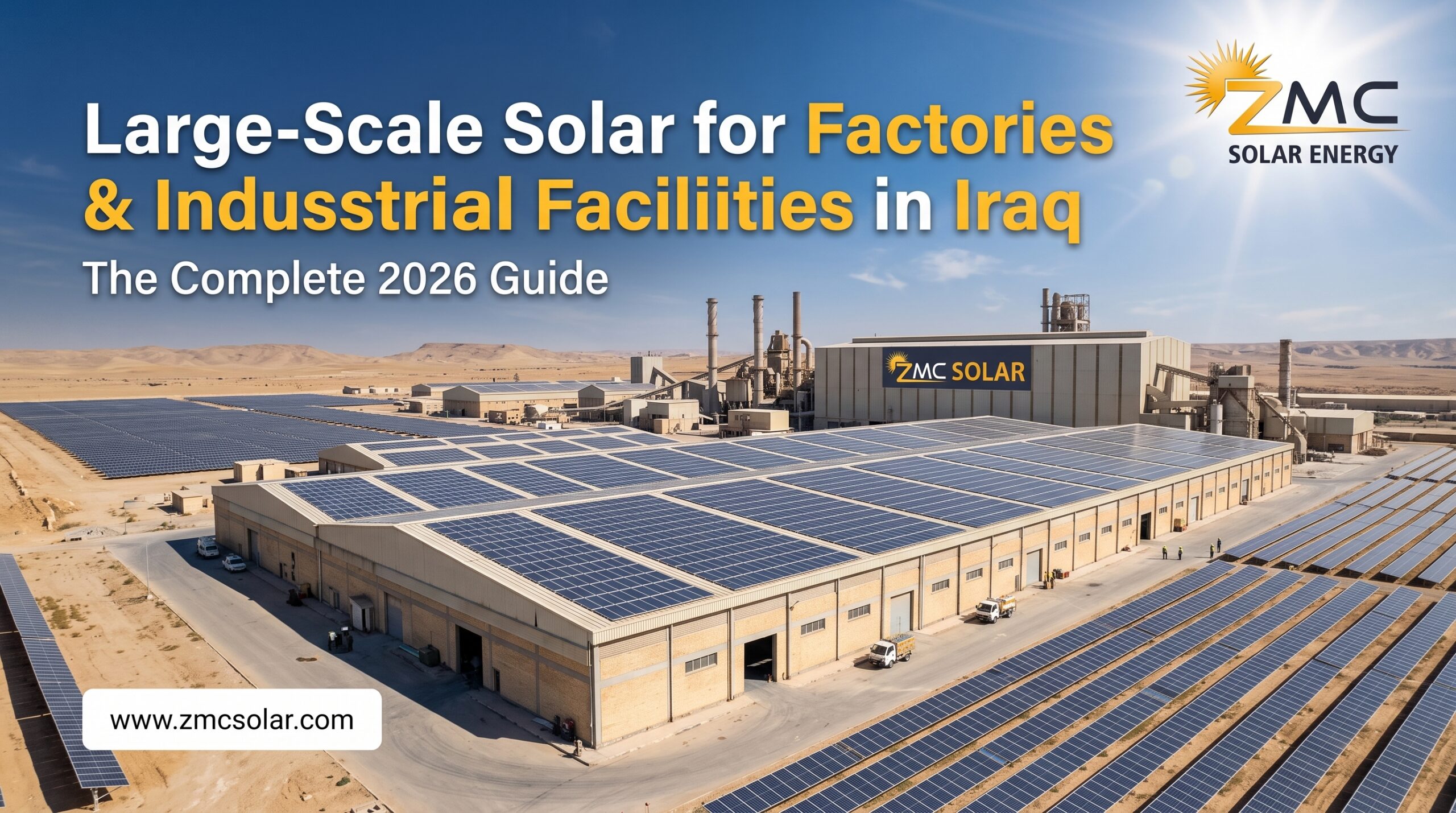
Large-Scale Solar for Factories & Industrial Facilities in Iraq: The Complete 2026 Guide
Solar for Factories, zmc solar energy, solar company in iraq, baghdad, erbil, best solar company
Large-Scale Solar for Factories & Industrial Facilities in Iraq | ZMC Solar

Iraq's factories are operating under conditions that would shut down a business anywhere else in the world. As of summer 2026, the national grid carries an 11,000-megawatt deficit — demand hits roughly 40 GW at peak while supply struggles to reach 29 GW. In central provinces like Najaf, Karbala, and Babil, factories endure up to 12 hours of daily blackouts, often during 50°C summer heat when production lines, refrigeration systems, and air conditioning are running hardest. The answer isn't more diesel. It's large-scale solar — and the economics in Iraq are now better than almost anywhere on earth. This guide covers everything a factory owner, operations director, or procurement manager needs to know: system types, costs, ROI timelines, sector-specific benefits, government incentives, and how to choose the right EPC partner to deliver the project.

11 GW Iraq national grid deficit (2026)
12 hrs Daily blackouts in central provinces
3,250 Sunshine hours per year in Iraq
3-5 yrs Typical factory solar payback period

Why Iraq's Factories Can't Afford to Ignore Solar in 2026

Iraq's electricity problem is not new, but 2026 has made it significantly worse. The disruption to Iranian gas imports — which previously supplied up to 30 million cubic meters per day to Iraqi power stations — reduced that supply by over 80%, removing a critical fuel source that generators across the country depended on. The knock-on effect for factories has been severe.

When the grid cuts out, factories face a binary choice: run on diesel generators at enormous cost, or shut down production entirely. Neither is acceptable. Diesel in Iraq currently costs between $0.35 and $0.65 per litre at commercial rates, and a mid-sized factory running a 500 kW generator for 10 hours burns through roughly 1,200 litres per day — a daily fuel bill that can exceed $700 before a single unit of productive output is made.

Solar eliminates that cost entirely. Iraq sits in one of the world's highest-irradiance zones, receiving approximately 3,250 sunshine hours per year and an annual solar yield of around 1,159 kWh per installed kilowatt-peak (kWp). According to the IRENA 2023 Renewable Power Generation Costs Report , industrial solar generation costs in high-irradiance regions like Iraq average just $40-$45/MWh compared to $120/MWh or more for fossil-fuel alternatives — roughly one-third the cost of the diesel currently burning in Iraqi factory generators.

How Much Power Does an Iraqi Factory Actually Need?

Before designing any system, the starting point is always a load assessment — an accurate picture of the facility's electricity consumption by hour, by season, and by production shift. Getting the system size wrong means either overpaying for unused capacity or running short during peak demand.

Small Factories and Workshops (50 kW - 200 kW peak demand)

Textile workshops, small food processing units, tile manufacturers, and light assembly lines. A 60-180 kWp solar array typically covers 60-80% of daytime consumption. These projects complete in two to six weeks and achieve the fastest paybacks.

Medium Industrial Facilities (200 kW - 1,000 kW peak demand)

Pharmaceutical plants, dairy processing facilities, cold storage warehouses, concrete and block manufacturing, and mid-scale steel workshops. Systems in this range run from 200 kWp to 1 MWp and require sophisticated inverter configurations and battery storage to manage load spikes.

Large Industrial Complexes (1 MW - 5 MW+ peak demand)

Cement plants, major food processing factories, large logistics and refrigeration hubs, auto parts manufacturing, and heavy industrial facilities. These are full EPC projects requiring detailed engineering surveys, utility-scale inverters, three-phase integration, and a custom grid interconnection agreement.

Three-Phase Power: The Critical Industrial Requirement

Most industrial machinery in Iraq operates on a three-phase 380V/400V supply, not the single-phase 220V used in homes. Large-scale factory solar systems require three-phase string inverters capable of delivering balanced three-phase output — essential for motors, compressors, pumps, and CNC equipment. Any contractor proposing a factory system without addressing three-phase integration should be disqualified immediately.

What Does a Large-Scale Industrial Solar System Include?

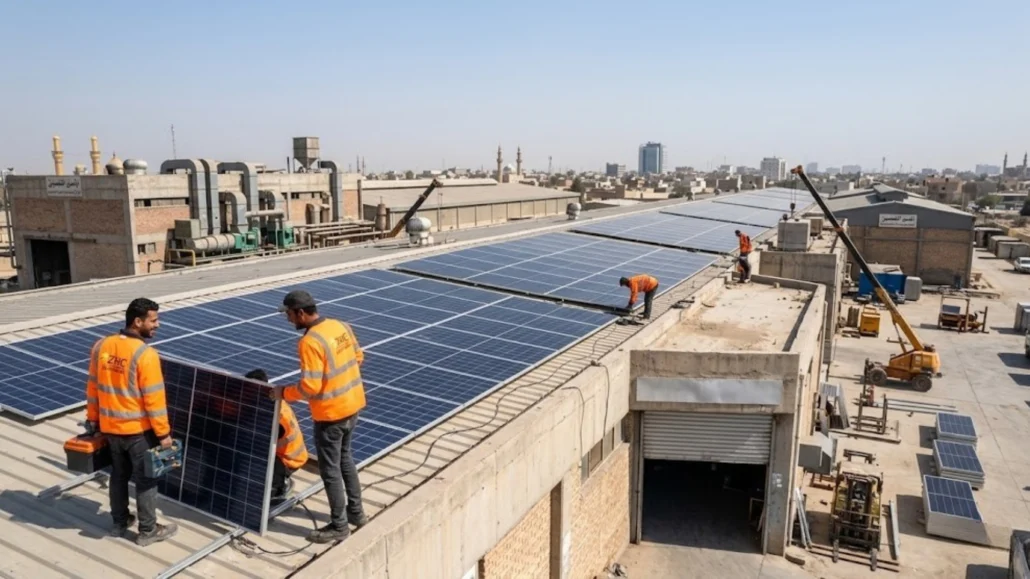
Solar PV Array — Tier-1 monocrystalline panels rated at 550 Wp-700 Wp each. For a 500 kWp system, that means roughly 715-900 panels covering 2,800-4,000 m² of roof or ground area. High-temperature performance matters enormously in Iraq, making module selection a critical engineering decision, not just a price comparison.

Industrial Inverters — Central or string inverters rated for three-phase output, with IP65 or higher weatherproofing for Iraq's dust and heat conditions. Systems above 100 kWp use multiple string inverters in parallel, sized with redundancy so a single failure does not halt production.

Battery Storage — For Iraqi factories, battery storage is not optional. Without it, solar generation stops the moment the grid cuts out. A battery bank covering four to eight hours of critical loads lets production continue through outages and into evening shifts.

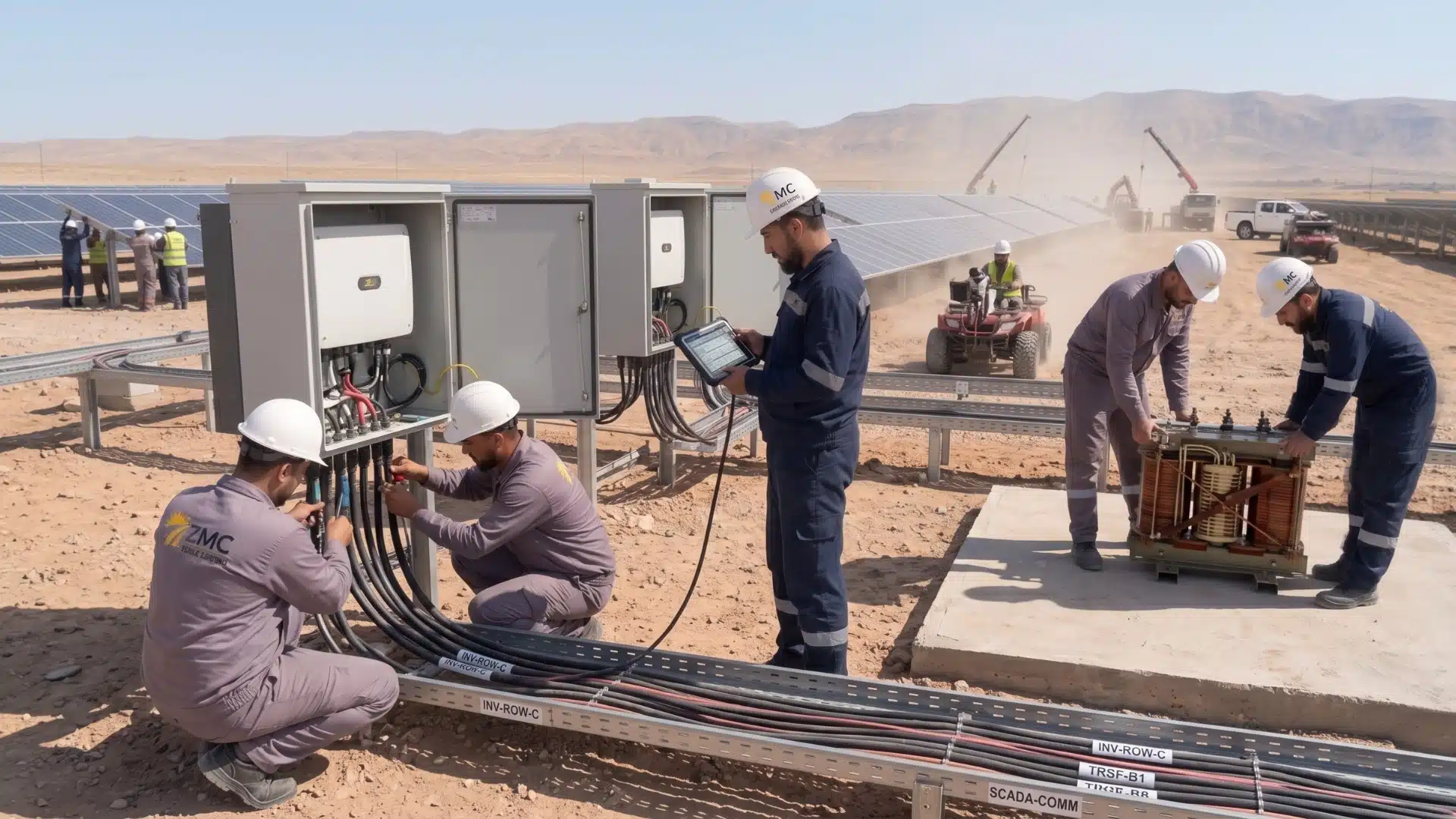
Monitoring and SCADA — Real-time production monitoring, fault detection, and data logging. A proper monitoring system gives facility managers visibility into generation, consumption, battery state, and grid export from a single dashboard.

Cabling, Switchgear, and Protection Systems — Often undercosted by inexperienced contractors. Industrial systems require DC cabling, AC circuit breakers, surge protection, DC isolators, anti-islanding protection, and a dedicated metering arrangement for grid-tied projects.

Mounting Structures — Rooftop, ground-mount, or carport configurations depending on available space. Industrial roofs in Iraq are typically flat concrete or ribbed metal sheeting; both are viable, but structural load calculations are mandatory before installation.

Industrial Solar Costs in Iraq: What to Budget in 2026

Solar panel prices have fallen to historic lows, and Iraq's reduced import tariffs on solar equipment mean those savings pass directly to the buyer. As a general benchmark for 2026:

System Size Typical Factory Type Cost per kWp (Installed) Estimated Total Cost
50-200 kWp Small workshop, light assembly $350-$550 $17,500-$110,000
200 kWp - 1 MWp Pharmaceutical, cold storage, concrete $300-$450 $60,000-$450,000
1 MWp+ Cement, heavy industrial, logistics $250-$380 $250,000+

Cost Comparison: Solar vs. Diesel vs. Grid

Energy Source Approx. Cost per kWh Notes
Industrial Solar (25-yr LCOE) $0.04-$0.06 Near-zero fuel cost after installation
Diesel Generator $0.28-$0.45 Fuel + maintenance + depreciation
Iraq Commercial Grid $0.046 Unreliable; 12+ hour outages daily
Fossil Fuel Power (utility-scale) $0.12 Iraq's own generation cost benchmark

Financing Available: The Central Bank of Iraq has allocated $850 million in subsidised loans for renewable energy installations. The National Investment Commission licenses qualifying projects under a 10-year tax exemption framework. Import duties on panels and inverters have also been significantly reduced — cutting procurement costs for large commercial buyers.

ROI and Payback Period for Factory Solar in Iraq

European factories typically achieve solar payback in five to eight years. In Iraq, the combination of high irradiance, high diesel costs, and minimal grid reliability pushes that figure down to three to five years for most installations.

Worked Example: 500 kWp System

Annual generation: 500 kWp x 1,159 kWh/kWp = 579,500 kWh/year

Diesel avoided at $0.35/kWh: $202,825 saved per year

Installation cost at $375/kWp: $187,500

Simple payback: 187,500 / 202,825 = approximately 11 months

Payback by Industry Sector

Sector Typical Payback Key Driver
Cold Storage / Food Processing 3.5-5 years High 24/7 refrigeration loads
Textile and Garment 3-4 years Daytime shifts align with solar peak
Concrete and Building Materials 4-5 years Heavy three-phase motor loads
Pharmaceuticals 4-6 years High uptime and clean power requirement
Logistics and Warehousing 4-5 years Large roof area; forklift charging

On-Grid, Off-Grid, or Hybrid? Choosing the Right System for Your Factory

On-Grid (Grid-Tied) Solar is the cheapest to install but has a critical flaw for Iraq: when the grid cuts out, on-grid systems automatically shut down for safety. A factory loses all solar power precisely during the worst outages. Not recommended as a standalone solution for Iraqi factories.

Off-Grid Solar operates entirely independently of the national grid — ideal for factories in remote areas away from established distribution infrastructure. It requires a larger battery bank but delivers complete energy independence.

Hybrid Solar is the recommended configuration for the vast majority of Iraqi factories. Solar is the primary source, batteries store surplus, the grid supplements when available, and the battery covers outages — switching in under 20 milliseconds, imperceptible to production equipment.

Solar by Factory Type: Which Industrial Sectors Benefit Most

Food Processing and Cold Storage

Food factories and cold chain facilities have the highest electricity demands and the least tolerance for power interruptions. A refrigeration system that loses power even briefly risks product spoilage and compliance failures. Solar with battery storage cuts electricity cost and eliminates the power gap that currently forces most cold storage operators to run diesel generators 24/7.

Cement, Concrete, and Construction Materials

Heavy three-phase motors power cement mixers, block presses, conveyor systems, and stone crushers. These facilities often have large, flat rooftops ideal for high-density solar arrays. Many plants have enough roof area to cover 80-100% of daytime production loads.

Textile and Garment Manufacturing

Sewing, weaving, and textile printing facilities run multiple machines simultaneously during daylight hours — a load profile that maps almost perfectly onto solar generation. Air conditioning is a major cost in Iraqi summer; solar peaks exactly when AC demand is highest.

Pharmaceuticals and Medical Manufacturing

GMP-compliant production requires stable, clean power. Generators introduce voltage irregularities that disrupt sensitive analytical equipment. A solar-hybrid system with a pure-sine-wave inverter delivers cleaner power than either the grid or a generator.

Water Treatment and Industrial Pumping

Large pump motors running for extended hours are predictable loads that map directly onto solar generation windows. Pumping applications carry some of the simplest engineering and fastest payback of any industrial solar installation.

Iraq's Solar Policy Support for Industrial Projects in 2026

Central Bank Solar Loan Programme: $850 million in subsidised financing for renewable energy installations. Industrial and commercial entities are eligible through participating commercial banks, with preferential rates and extended repayment terms.

10-Year Tax Exemptions: Projects licensed by the National Investment Commission under the renewable energy framework receive a 10-year exemption from corporate income tax attributable to the project.

Reduced Import Tariffs: Panels, inverters, mounting systems, and storage equipment imported for renewable energy projects now carry significantly reduced tariff rates, directly lowering procurement costs for large-scale installations.

Iraq's 2030 Renewable Energy Target: Iraq aims for 12 GW of installed renewable capacity by 2030, representing 33% of total electricity supply. Only approximately 42 MW is currently installed — meaning the government must approve an enormous volume of commercial and industrial solar projects over the next four years. Factory owners who act now benefit from the strongest policy tailwind this market has ever seen.

How to Choose a Solar EPC Contractor for Your Factory in Iraq

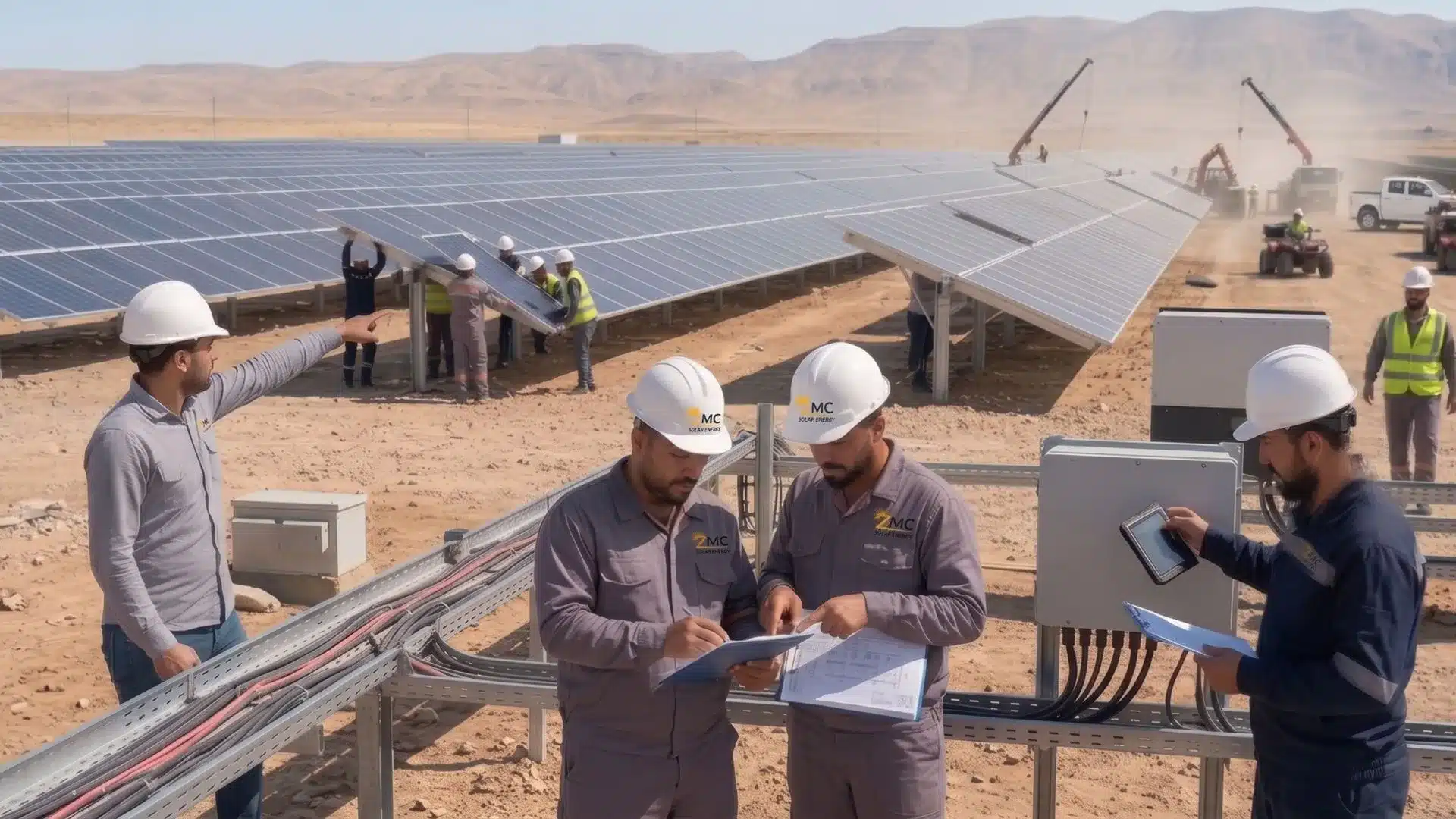
Engineering, Procurement, and Construction (EPC) is the turnkey solar project delivery model — one company manages everything from feasibility study to commissioning. For industrial projects, EPC is the only responsible approach. Selecting the wrong contractor is the most common source of industrial solar project failures.

Documented industrial project experience. Ask for a portfolio of completed factory, warehouse, or manufacturing facility projects specifically — not residential jobs. Request commissioning reports and client references you can contact directly.

In-country engineering teams. Iraq's construction environment requires engineers who understand local structural standards, grid interconnection procedures, and on-site logistics. Remote engineering introduces unnecessary risk on a multi-hundred-thousand-dollar project.

Tier-1 equipment only. Tier-1 is a financial classification reflecting the manufacturer's ability to honour warranties. For a system expected to operate for 25 years, it is the minimum acceptable standard — not a premium option.

Local spare parts availability. Industrial systems cannot wait weeks for a replacement inverter to arrive from overseas. Verify your contractor maintains local stock of critical spare parts and has service engineers available for on-site response.

Transparent, itemised proposals. A professional EPC contractor provides a line-by-line breakdown of every cost: panels, inverters, batteries, mounting, cabling, labour, civil works, commissioning, and warranty terms. Lump-sum quotations without itemisation conceal where corners may be cut.


Frequently Asked Questions

A large-scale solar system for a factory in Iraq costs between $250 and $550 per installed kilowatt-peak (kWp), depending on system size, battery storage specification, and site complexity. A 500 kWp system suitable for a mid-sized factory typically costs $150,000-$225,000 fully installed. Larger systems above 1 MWp achieve lower per-unit costs. Central Bank of Iraq subsidised loans are available for qualifying industrial projects.
Industrial solar in Iraq typically achieves a simple payback period of 3 to 5 years for factories currently running diesel generators. A factory with a monthly diesel bill of $15,000 can expect annual solar savings of $130,000-$180,000. Over a 25-year panel life, net savings routinely exceed $2 million per MW of installed capacity.
A solar system should be sized to cover 70-100% of daytime production loads, with battery storage for evening shifts and outages. A factory with 300 kW peak demand typically requires a 300-400 kWp solar array and 400-800 kWh of battery storage. ZMC Solar conducts a free site assessment and load analysis before any system is specified.
Yes. Off-grid solar with battery storage is often the most cost-effective solution for factories outside major cities or in areas with limited grid infrastructure. Off-grid systems operate completely independently of the national grid, eliminating fuel logistics and generator maintenance entirely. ZMC Solar has delivered off-grid and hybrid projects across Iraq, including in governorates with limited grid coverage.
A hybrid solar system makes solar the primary power source during daylight hours. Surplus generation charges the battery bank. When solar output drops, the battery discharges to maintain production. The generator is kept as a tertiary backup only. Most factories with a properly sized hybrid system find their generators run fewer than 10-15 days per month, compared to daily current operation.
Iraq's extreme heat and high irradiance require monocrystalline panels with high-temperature coefficients, IP68-rated junction boxes, and anti-reflective coated glass. Canadian Solar's HiKu series, which ZMC Solar supplies as an authorised distributor, is engineered for high-temperature environments and deployed across commercial projects throughout the Middle East.

Ready to Stop Paying for Diesel?

Iraq's power crisis is not resolving in the short term. ZMC Solar's engineering team covers Baghdad, Erbil, Basra, Sulaymaniyah, Mosul, Kirkuk, and all surrounding provinces. Book a no-obligation site assessment and get a full ROI projection for your facility.

Book a Free Factory Solar Consultation
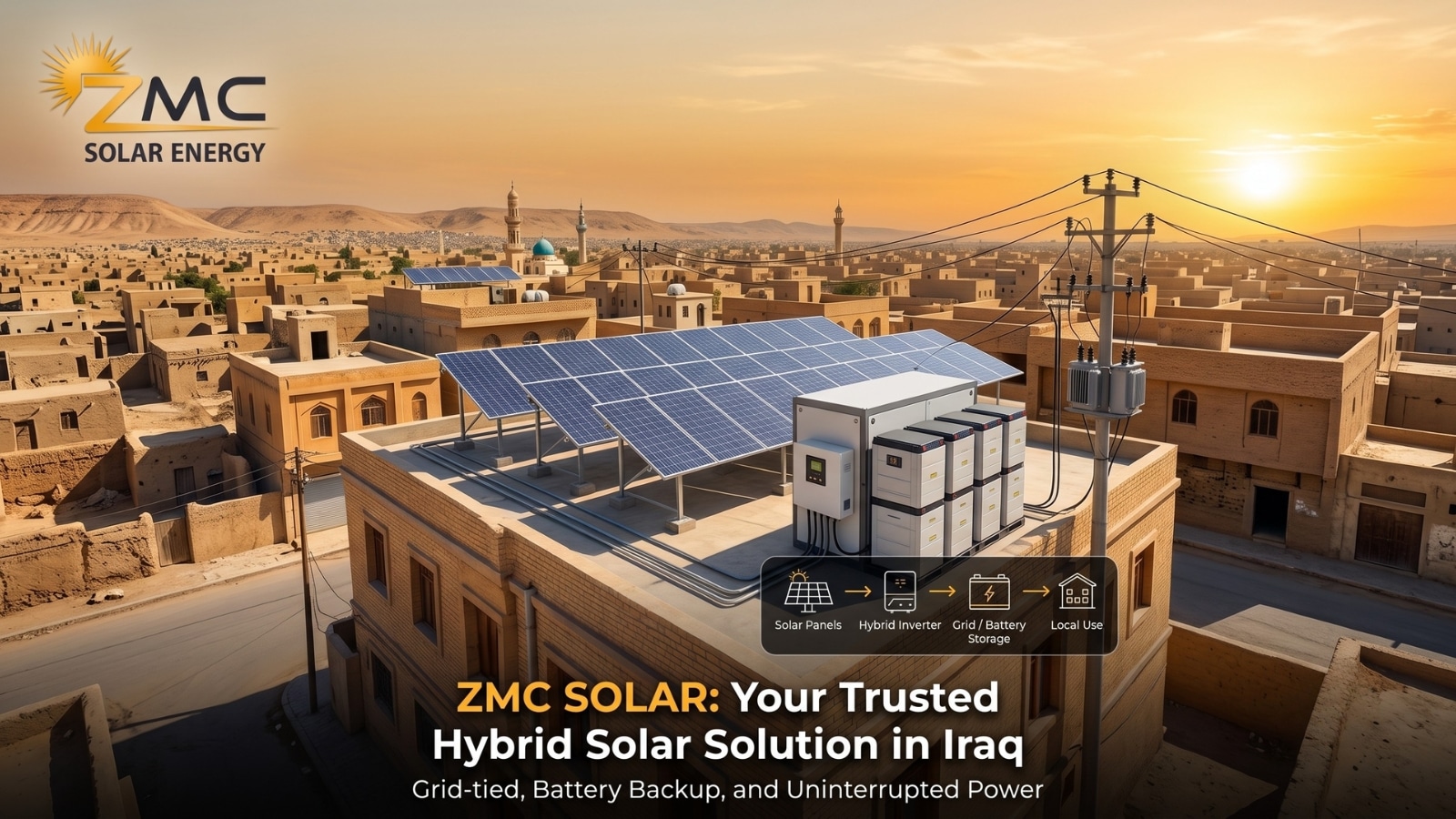
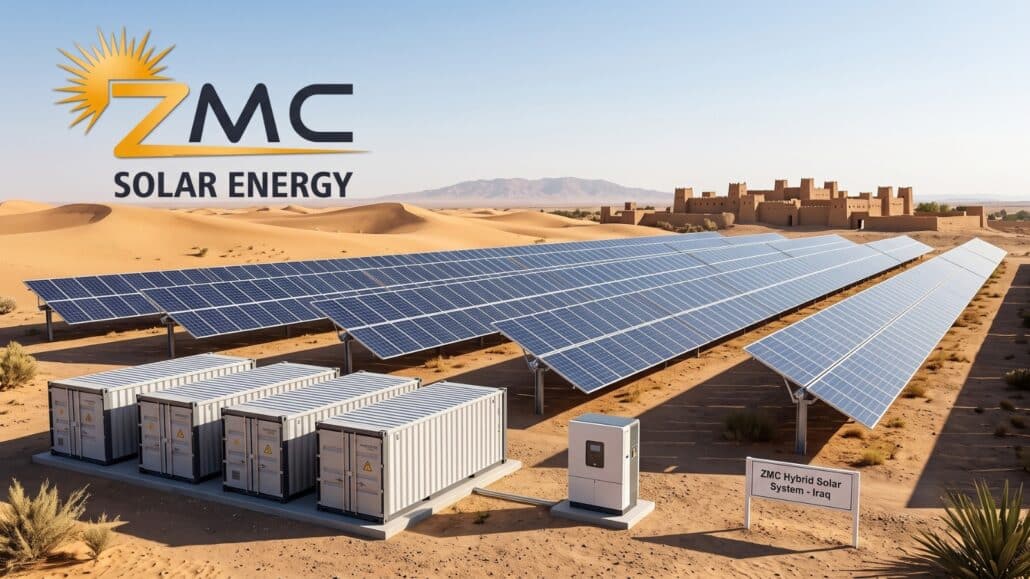
Hybrid Solar System in Iraq: The Complete 2026 Guide for Homes and Businesses

Hybrid Solar System in iraq

A hybrid solar system in Iraq is the smartest energy investment an Iraqi home or business can make in 2026. It connects solar panels, a lithium battery bank, and the national grid into one intelligent system — giving you clean power during the day, stored backup power at night, and automatic switching in under 10 milliseconds the moment the grid goes down. No generator. No fuel costs. No waiting in the dark.

Iraq generates roughly 18,000 MW of electricity against demand that exceeds 30,000 MW, surging to 50,000 MW in summer. That gap is why hybrid solar — not a standard grid-tied system — is the right answer for most Iraqi households and businesses in Baghdad, Erbil, and beyond. This guide explains exactly how hybrid systems work, what they cost, what government financing is available, and how to choose the right size for your needs.

What Is a Hybrid Solar System?

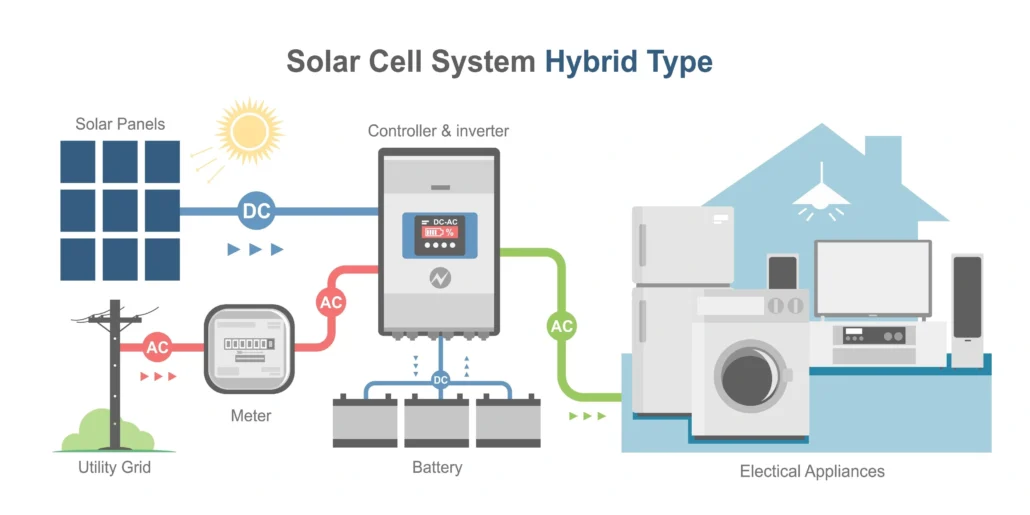
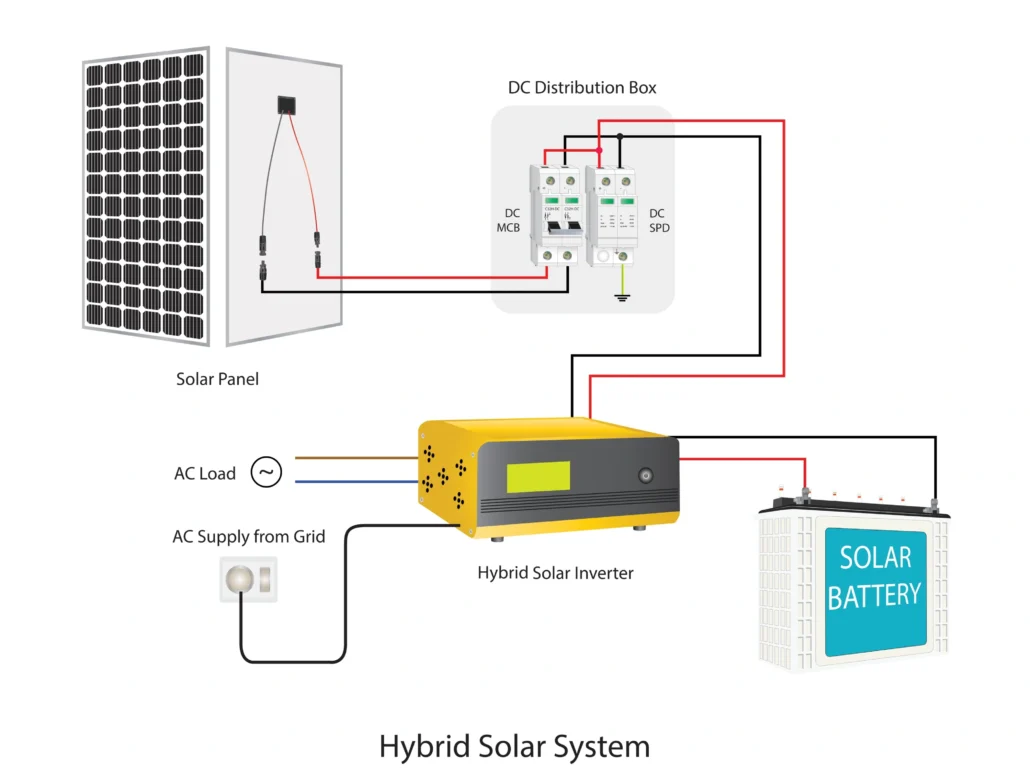
A hybrid solar system is a power setup that combines the best features of both grid-tied and off-grid solar installations. It uses solar panels to generate electricity, stores surplus energy in a battery bank, and stays connected to the national grid as a backup — all managed by a single hybrid inverter that makes decisions automatically.

The key difference from a standard solar system is the battery. A grid-tied system (on-grid) sends unused solar power back to the grid but leaves you powerless during a grid failure. A hybrid system stores that same surplus in your own batteries, so when the grid cuts out, your home or business keeps running without interruption.

In Iraq, where outages can last 8–16 hours per day depending on the season, this distinction is not a minor feature — it is the entire point.

Why Iraq Needs Hybrid Solar Specifically

Iraq enjoys over 3,000 hours of sunshine annually, making it one of the best countries in the world for solar energy production. Yet despite this natural abundance, the country’s electricity infrastructure has long struggled to keep pace with demand. The energy shortfall reached approximately 12,000 MW during the 2025 summer peak and is expected to remain a challenge through the decade.

The result for households and businesses is an uncomfortable dependence on diesel generators — expensive, loud, polluting, and increasingly difficult to justify when solar alternatives exist. A hybrid solar system eliminates this dependence by:

  • Running your appliances on free solar power during daylight hours
  • Storing excess generation in a battery that powers your home after sunset
  • Using the grid only when both solar and battery are insufficient
  • Switching to battery backup in under 10 milliseconds during a grid failure, invisibly and automatically

Two additional policy changes in 2026 make this the most cost-effective time to install. In March 2026, Iraq cut import tariffs on solar equipment from 33% to 5%, directly reducing hardware costs. The Central Bank of Iraq has also allocated IQD 6 trillion through Cihan Bank and Rasheed Bank to finance residential solar purchases at low or zero interest — with loan amounts up to 30 million IQD (approximately $22,890) and repayment periods up to seven years.

HOW IT WORKS

How a Hybrid Solar System Works

Understand how solar panels, batteries, hybrid inverters, and the grid work together to keep your home powered throughout the day and night.

01

Solar Generation

During daylight hours, your solar panels convert sunlight into DC electricity. In Iraq's climate, a quality 400W panel can produce approximately 1.5–2 kWh per day, with output peaking between 9 a.m. and 3 p.m.

02

Hybrid Inverter Management

The hybrid inverter converts DC power from the panels into AC power for your appliances. It simultaneously monitors battery charge level, grid status, and your household load, then automatically decides how to allocate available power.

03
🔋

Battery Charging

Any solar electricity your home does not use in real time flows into the battery bank. Modern LiFePO₄ lithium batteries charge rapidly and can operate safely at temperatures up to 55°C — a critical requirement for Iraq's summer climate.

04

Night & Grid-Failure Mode

When the sun sets or the grid cuts out, the inverter switches to battery power in less than 10 milliseconds. For most appliances — including air conditioners, refrigerators, medical equipment, and computers — this switchover is completely unnoticeable.

05
🔌

Grid Fallback

If your batteries run low overnight and the grid is available, the system pulls a small amount from the grid to top up, preventing a complete blackout. You control the minimum battery reserve level through the inverter's settings or a smartphone app.

SYSTEM COMPONENTS

Key Components of a Hybrid Solar System in Iraq

Every hybrid solar system consists of four core elements. The quality of each component determines long-term reliability, efficiency, and performance in Iraq's demanding climate.

01

Solar Panels

Solar panels are the engine of the system. For Iraq's high-temperature, high-irradiance environment, you need panels rated for performance in extreme heat. Standard panels lose output efficiency above 25°C, while premium-grade modules use temperature coefficients designed to maintain higher output during summer peak temperatures.

Canadian Solar panels — distributed by ZMC Solar — are Tier-1 certified and include performance warranties that account for high-temperature degradation, making them a proven choice for the Iraqi climate. Most residential systems use between 6 and 20 panels depending on household energy consumption.

02

Hybrid Inverter

The hybrid inverter is the brain of the system. Unlike a standard inverter, it manages three simultaneous inputs — solar panels, battery bank, and grid connection — and switches between them automatically without user intervention.

Look for models with MPPT (Maximum Power Point Tracking) charge controllers, which improve energy transfer efficiency by up to 30% compared to older PWM technology.

For Iraqi conditions, an inverter with a wide input voltage range, high ambient temperature tolerance, and a minimum IP65 dust/moisture rating is essential to protect against sandstorms.

03
🔋

Lithium Battery Storage

The battery bank is what makes a hybrid system genuinely useful in Iraq. In 2026, LiFePO₄ (Lithium Iron Phosphate) batteries are the clear standard.

6,000+ Charge Cycles
10+ Years Typical Lifespan
55°C Operating Temperature

They deliver 6,000+ charge cycles at 80% depth of discharge, last 10 years or more, operate safely at temperatures up to 55°C, and charge significantly faster than lead-acid alternatives.

For a household of four to six people in Baghdad or Erbil, a 10 kWh battery bank provides approximately 8–12 hours of backup power under normal load. A 15 kWh bank extends that coverage to 16+ hours, comfortably covering the longest grid outages.

Explore solar battery options in Iraq to compare capacities and brands available through ZMC Solar.

04
🔧

Mounting, Wiring & Charge Controllers

Quality mounting hardware rated for corrosion resistance matters in Iraq's sandy, high-UV environment. Frames should be anodized aluminum or galvanized steel, capable of handling wind loads and thermal expansion.

The wiring and conduit must be UV-rated for rooftop exposure. These components are often underestimated in budget comparisons but significantly affect system longevity, safety, and long-term performance.

Built for Iraq's Climate

Choose corrosion-resistant mounting, UV-rated wiring, and properly protected electrical connections for long-term reliability.

Why Component Quality Matters

A hybrid solar system is only as reliable as its weakest component. Choosing equipment designed for Iraq's heat, dust, UV exposure, and grid conditions helps maximize energy production and system lifespan.

2026 SOLAR PRICING

How Much Does a Hybrid Solar System Cost in Iraq?

With the 2026 tariff reduction in effect, hybrid solar system pricing in Iraq has become significantly more accessible. The ranges below reflect typical installed costs for complete systems.

SMALL SYSTEM

5 kW + 10 kWh

$4,500 – $7,000

Suitable for: Small apartment / 2–3 rooms

  • 5 kW solar capacity
  • 10 kWh battery storage
  • Residential installation
  • Panels, inverter, wiring & labour
LARGE SYSTEM

15 kW + 20 kWh

🔋
$13,000 – $18,000

Suitable for: Large home / small business

  • 15 kW solar capacity
  • 20 kWh battery storage
  • Higher daily energy production
  • Residential & light commercial use
COMMERCIAL

30 kW+

🏢
$25,000 – $40,000+

Suitable for: Shop, clinic, small hotel

  • 30 kW+ solar capacity
  • Commercial-scale battery storage
  • Designed for higher energy loads
  • Commercial installation & labour
i
What is included in these prices?

These figures represent typical installed costs including solar panels, hybrid inverter, battery bank, mounting, wiring, and labour. They do not include government loan offsets. Actual pricing can vary depending on equipment brands, installation requirements, system configuration, location, and battery capacity.

INVESTMENT RETURN

How Quickly Can a Solar System Pay for Itself?

< 4
Years

Typical residential payback period, depending on energy consumption and system configuration.

< 3
Years

Potential commercial payback period where generator and grid costs are significantly higher.

For most residential installations, the payback period — the point at which energy savings offset the upfront cost — is now under four years. Commercial systems with higher baseline generator costs can often recover their investment in under three years.

SYSTEM SIZING

What Size Hybrid Solar System Do You Need?

Sizing your system correctly is one of the most important technical decisions you will make. An undersized system leaves you with unmet energy needs, while an oversized system costs more upfront than necessary.

Start With Your Daily Energy Consumption

The starting point is your daily energy consumption in kilowatt-hours (kWh). You can estimate this by listing your main appliances and calculating how many hours you use each one.

COOLING

1.5-Ton Air Conditioner

≈ 1.5 kWh / hour
APPLIANCE

Refrigerator

≈ 1–1.5 kWh / day
LIGHTING

LED Lighting — Full Home

≈ 1 kWh / day
ENTERTAINMENT

Television

≈ 0.1–0.2 kWh / hour

Not Sure What Size System You Need?

A professional site assessment can help determine the right panel, inverter, and battery capacity for your actual energy consumption.

NO-OBLIGATION
ASSESSMENT
SYSTEM COMPARISON

Hybrid vs. Off-Grid vs. On-Grid: Which Is Right for Iraq?

The three main solar configurations each suit different situations. Here's how they compare for homes and businesses in the Iraqi context.

Feature On-Grid Off-Grid RECOMMENDED Hybrid
Works during grid outage No Yes Yes
Requires battery storage No Yes Yes
Grid connection Required Not used Optional
Upfront cost Lowest Highest Mid-range
Best for Iraq? No Rural only Yes — most homes
LOWEST COST

On-Grid

On-grid systems are the least expensive option because they do not require batteries. However, they stop producing usable power during a grid outage, which makes them a poor fit for areas with unreliable electricity.

🔋
INDEPENDENT

Off-Grid

Off-grid systems operate completely without the utility grid, making them useful for remote or rural locations. The trade-off is a much larger battery bank to cover overnight use and consecutive low-sun days.

Why Hybrid Systems Make the Most Sense in Iraq

Hybrid systems hit the right balance for most Iraqi households: reliable backup power during outages, lower battery requirements than a fully off-grid system, and the utility grid available as a safety net rather than a dependency.

For a more detailed technical breakdown of system design, battery requirements, and operating differences, read our on-grid vs. off-grid solar comparison .

Frequently Asked Questions

Can a hybrid solar system run AC in Iraq's summer?

Yes. Solar power can run your AC during the day, while batteries provide power during the evening and grid outages. For a 1.5-ton air conditioner, you need at least a 5 kW solar array and 10 kWh battery, although the exact requirement depends on the AC's efficiency, usage hours, other household loads, and desired backup duration.

How long do solar batteries last in Iraq's heat?

LiFePO4 lithium batteries are designed to handle high temperatures and can operate at temperatures of up to 55°C. With proper installation and thermal management, they can typically last around 10–15 years. This is significantly longer than traditional lead-acid batteries, which may last only 3–5 years under demanding conditions.

Is there government support for buying a solar system in Iraq?

Yes. Government-backed financing has helped make solar systems more accessible in Iraq. The Central Bank of Iraq's solar financing programme has included loans of up to 30 million IQD, approximately $22,890, with repayment periods of up to seven years and favourable financing terms. Solar import tariffs were also reduced to 5% in 2026.

How fast does a hybrid system switch during a power cut?

A properly configured hybrid inverter can switch to battery backup in under 10 milliseconds, depending on the inverter model and operating mode. This is fast enough that many household devices continue operating without an obvious interruption.

What is the payback period for a hybrid solar system in Iraq?

A typical residential hybrid solar system in Iraq may have a 3–5 year payback period, while commercial installations with high electricity or generator costs can potentially recover their investment in under three years. Actual payback depends on system cost, energy consumption, generator usage, grid availability, battery cycling, and solar production.

```html ```
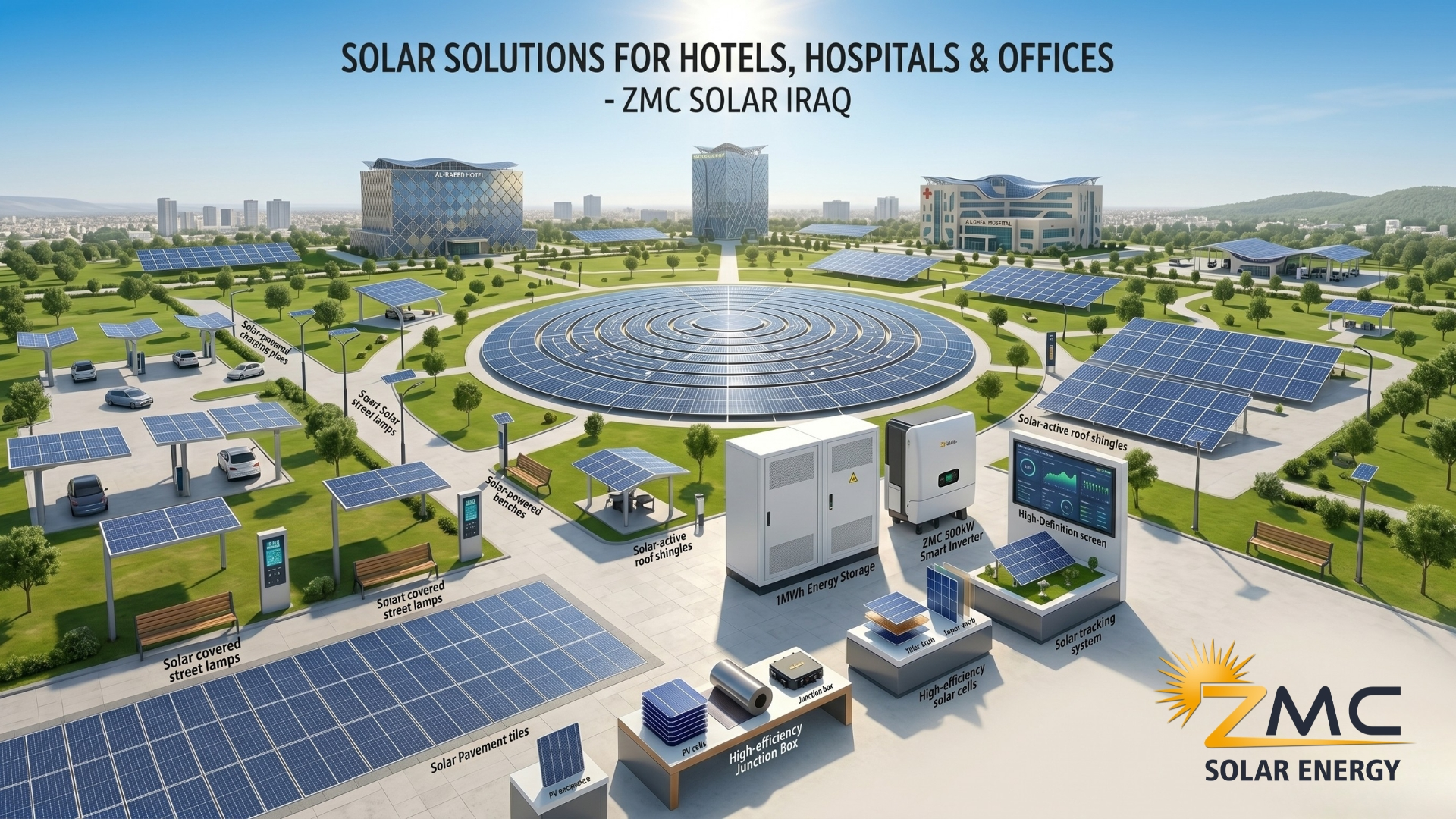
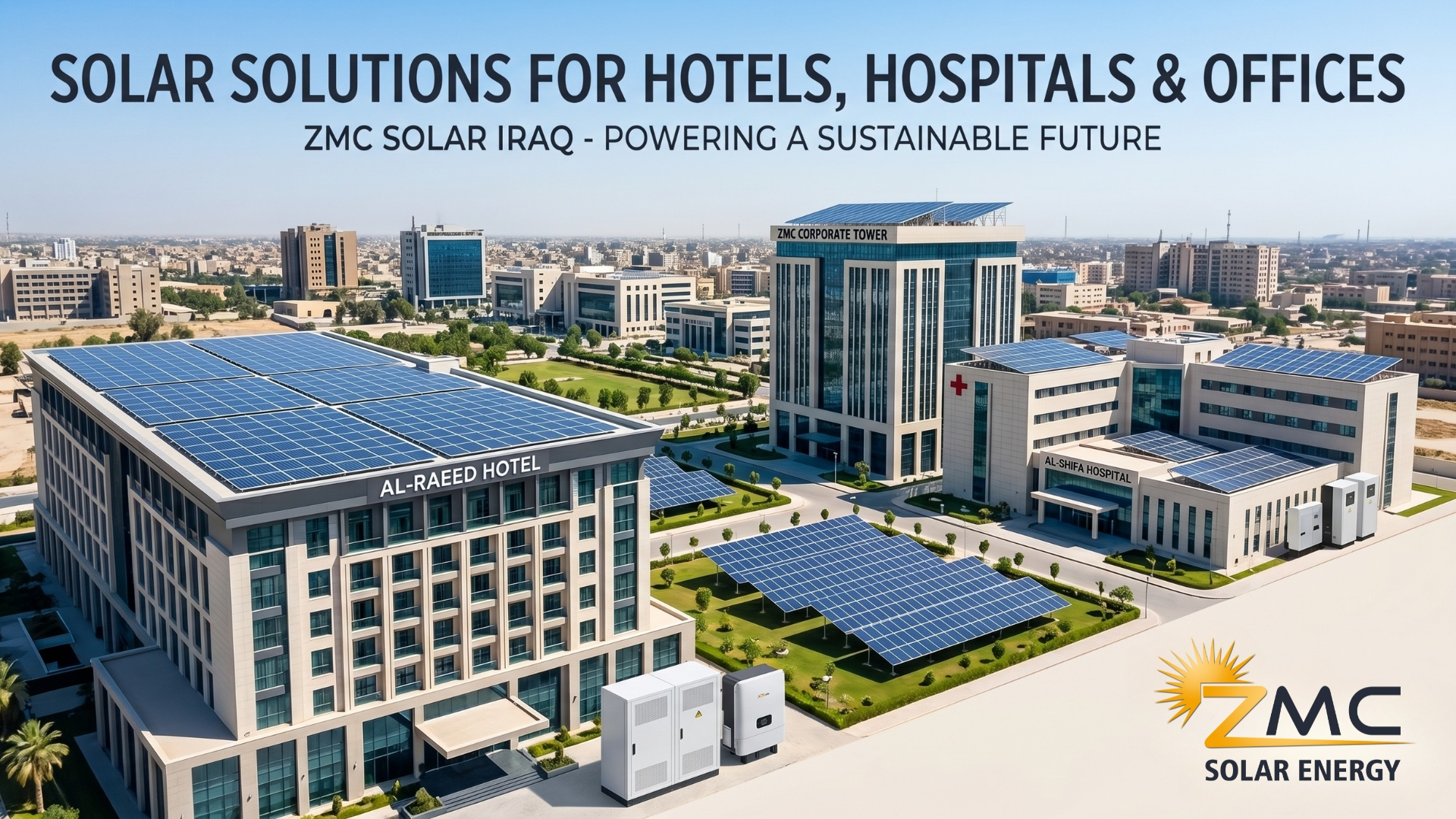
Your hotel, hospital, factory, warehouse, or university runs on diesel generators today. It doesn’t have to. ZMC Solar delivers complete solar EPC services across Iraq from engineering and equipment procurement to installation, commissioning, and after-sales support under a single contract with one accountable partner. ZMC Solar is the top Solar EPC Contractor in Iraq serving all the Iraqi Province with the Tire-1 world class brands like Canadian Solar, itel, Dyque.
Full EPC Delivery
Canadian Solar · itel · DYQUE
Baghdad · Erbil · Basra
Loan Support

What Is a Solar EPC Contractor and Why Does It Matter in Iraq?

EPC stands for Engineering, Procurement, and Construction, the three phases that make up a complete, turnkey solar project. A solar EPC contractor in Iraq is a single company that handles all three phases under one contract, delivering a fully operational solar system from first consultation to final commissioning.

For large entities like hotels, hospitals, factories, universities, government buildings, and commercial complexes, this single-contract model is not just convenient. It is the only model that makes commercial sense. A hotel that hires three separate companies for engineering, equipment supply, and installation creates coordination risk, warranty complexity, and accountability gaps that can delay a project by months and add cost at every junction.

When a single EPC contractor owns all three phases, the engineering is designed around the equipment that will actually be procured, the installation team knows the design intimately, and accountability for the system’s performance sits with one entity for the life of the warranty. In Iraq’s demanding climate, where summer temperatures exceed 50°C and dust storms can reduce panel efficiency by 25% without proper engineering, this integrated accountability is the difference between a system that performs for 25 years and one that fails in three.

The Three EPC Phases — What ZMC Solar Delivers on Every Commercial Project

E
Engineering

Site Assessment & System Design

Full energy audit of your facility. Load analysis across all circuits. Digital twin of your building using precision software to model panel placement, shading from parapet walls and AC units, wind loading for desert conditions, and projected energy yield per month. System sizing in kW or MW matched exactly to your consumption profile — not a generic template.

P
Procurement

Tier-1 Equipment Supply

ZMC Solar is the official Iraq distributor for Canadian Solar, itel, and DYQUE — all Tier-1 internationally certified brands. As a distributor with local warehouse stock in Baghdad and Erbil, we procure your project equipment from our own inventory. No import delays, no counterfeit risk, no supply chain uncertainty. Every component arrives certified, warranted, and ready for installation.

C
Construction

Installation & Commissioning

Structural mounting using hot-dip galvanised aluminium frames tilted at the optimum angle for Iraq's latitude. Double-insulated cabling that withstands UV and heat degradation. Inverter installation and battery storage integration. Full system commissioning with performance testing against projected yield. Handover with monitoring platform access so you can track output in real time from day one.

Commercial Sectors ZMC Solar Serves as EPC Contractor in Iraq

ZMC Solar has engineering experience across every major commercial and institutional sector in Iraq. The following entities have the most to gain from a full solar EPC programme because their electricity costs are highest, their operational continuity requirements are strictest, and their roof or ground area is large enough to accommodate systems that generate real payback.

Hotels & Resorts

24/7 AC, water heating, kitchen, and lighting loads make hotels one of Iraq's highest electricity consumers. Solar plus battery storage eliminates dependence on both the grid and generators, reducing operating cost and providing a genuine marketing differentiator to guests.

Hospitals & Clinics

Power continuity is non-negotiable in a hospital. A solar hybrid system with battery backup ensures ICUs, operating theatres, and life-critical equipment never depend on an unreliable grid or a generator that can run out of fuel. ZMC Solar designs hospital systems to zero-failure standards.

Factories & Manufacturing

Industrial electricity consumption is high and constant. Solar eliminates the production downtime that grid cuts cause and the fuel cost of running backup generators around the clock. Large roof areas on factory buildings make them ideal for high-capacity solar arrays.

Office Complexes & Commercial Towers

Daytime electricity demand from offices aligns perfectly with peak solar generation hours. Rooftop solar covers the majority of a commercial building's daytime load, reducing electricity costs by 60–80% during working hours.

Universities & Schools

Educational institutions operate on fixed budgets where generator fuel costs consume a disproportionate share of resources. Solar EPC projects for universities in Iraq free up operating budgets while providing a visible sustainability commitment to students, staff, and the community.

Malls & Retail Centres

Air conditioning is the dominant load in Iraqi retail, and the cost of generator fuel to run it is one of the largest operating expenses for mall operators. A rooftop solar system sized to the cooling load creates immediate and measurable monthly savings.

Warehouses & Logistics Facilities

Large flat roofs, consistent daytime electricity consumption, and high generator dependency make warehouses one of the strongest ROI cases for solar in Iraq. ZMC Solar works with logistics companies across Baghdad, Basra, and Erbil.

Government Buildings & Ministries

Government entities in Iraq carry significant electricity costs across large facilities. Solar EPC projects align with Iraq's national target of 12 GW solar capacity by 2030 and qualify for Central Bank financing programmes specifically designed for institutional projects.

Why 2026 Is the Critical Year for Commercial Solar EPC in Iraq

Three structural changes converged in 2026 to create the strongest commercial case for solar investment Iraq has ever seen, and for large entities, the combination of these factors makes this the optimal window to commission an EPC project.

01
33% 5%

Import Tariffs Cut

The most significant single policy change for the Iraqi solar market in a decade. Before March 2026, importing solar panels and equipment into Iraq carried customs duties of up to 33%. The government reduced this to 5%, directly reducing the procurement cost of every commercial solar project. For a large commercial installation, this tariff reduction represents a meaningful reduction in project cost that flows directly into improving the payback period.

02
6 Trillion IQD

Central Bank Solar Loan Programme

The Central Bank of Iraq allocated 6 trillion Iraqi Dinars specifically for solar financing. Business loans are available through partner banks including Cihan Bank and Rasheed Bank, allowing commercial entities to commission a full EPC solar project without paying the entire cost upfront. Monthly loan repayments are typically lower than the monthly fuel cost savings from eliminating generator dependency — the loan effectively pays for itself from day one.

03
Record Lows

Solar Panel Prices at Historic Lows

Panel prices globally have fallen dramatically over the last decade. In 2026, quality Tier-1 commercial solar panels cost significantly less per watt than five years ago. Combined with the tariff reduction, this means the total installed cost of a commercial solar system in Iraq is at its lowest point in history, while energy yields remain unchanged because Iraq's sunlight is not going anywhere.

The result for commercial EPC clients

For most commercial projects in Iraq in 2026, the simple payback period is now under 3 years. After that threshold, the business runs on effectively free electricity for the remaining life of the system, typically 25 to 30 years. No other capital investment in Iraq delivers this combination of speed of return and duration of benefit.

ZMC Solar's EPC Project Process — From First Consultation to Commissioning

1

Free Site Assessment

Our engineers visit your facility, audit your electricity consumption, assess your roof or ground area, and identify the optimal system configuration. No cost, no obligation.

2

Engineering Report & Custom Quote

Full itemised proposal covering system size, equipment specification, projected monthly energy yield, payback calculation, and project timeline. Priced for your specific facility — not a generic template.

3

Contract & Financing

EPC contract signed. If financing via Central Bank loan, ZMC Solar provides the technical documentation required for bank application. Equipment confirmed from our Baghdad/Erbil warehouse stock.

4

Procurement

All Tier-1 equipment drawn from ZMC Solar's local warehouse. No import delays. Canadian Solar panels, itel inverters and batteries, DYQUE storage units — all certified and warranted.

5

Construction & Installation

ZMC Solar engineering crews install mounting structures, panels, cabling, inverters, and battery storage. Work is supervised and quality-checked at every stage against the engineering design.

6

Commissioning & Handover

Full system testing against projected yield. Monitoring platform activated. Client team trained on system operation. Warranty documentation issued. Ongoing support from our Baghdad and Erbil offices.

Tier-1 Equipment on Every ZMC Solar EPC Project

Every commercial solar EPC project ZMC Solar delivers uses internationally certified Tier-1 equipment from brands we officially distribute in Iraq. As the official distributor, we hold local warehouse stock in Baghdad and Erbil, which means your project equipment is available immediately, with no import lead time and no risk of counterfeit or grey-market products entering the supply chain.

Solar Panels

Canadian Solar

N-Type TOPCon technology engineered for high-temperature performance — critical in Iraq's 50°C+ summers. Bifacial modules capture reflected ground radiation for up to 30% additional output. Industry-leading low thermal coefficient ensures minimal efficiency loss as temperature rises.

Inverters & Battery Storage

itel

Hybrid inverters designed for Iraq's grid instability — seamlessly managing solar input, battery storage, and grid or generator backup. Lithium Iron Phosphate (LiFePO4) battery systems built for Iraq's heat, with cycle life that far exceeds conventional lead-acid alternatives used in older installations.

All-in-One Energy Storage

DYQUE

Integrated power conversion and high-capacity lithium storage in a single ruggedised unit. Ideal for commercial projects requiring large-scale battery backup without multiple separate components. Designed and tested for demanding climates, specifically suited to Iraq's desert operating conditions.

Commercial Solar EPC Pricing in Iraq — What Determines Your Project Cost

Project pricing — custom engineered per client

Important: Commercial solar EPC projects cannot be quoted from a price list. Every project is custom-engineered based on your specific facility, load profile, and equipment requirements. The factors below determine your project cost — and the only way to get an accurate figure is a free site assessment by ZMC Solar's engineering team.

System size (kW or MW)

Determined by your facility's electricity consumption profile — daily kWh usage, peak demand, and seasonal variation across summer and winter loading.

Building type and roof structure

Flat concrete roofs, sloped roofs, ground-mounted systems, and carport structures all have different mounting requirements and structural engineering costs.

Battery storage capacity

The amount of lithium storage required depends on how many hours of grid-independence you need — a hospital with zero-failure requirements needs significantly more battery than an office building with flexible backup tolerance.

Inverter configuration

Single large inverter vs multiple string inverters, hybrid vs on-grid only — determined by your load profile, battery requirements, and grid connection status.

Site conditions and access

Roof height, load-bearing capacity, existing electrical infrastructure, and site access all affect installation complexity and timeline.

Location in Iraq

Logistics and installation costs vary between Baghdad, Erbil, Basra, and other provinces. ZMC Solar operates across all major Iraqi cities.

What ZMC Solar can confirm: for every commercial project we have delivered in Iraq, the monthly fuel and electricity savings exceed the monthly loan repayment, meaning the system pays for itself from the first month of operation when financed through the Central Bank programme. The exact saving depends on your current generator fuel cost, which varies by facility size and operational hours.

Contact our engineering team for a free site assessment. You will receive a full itemised proposal including system size, equipment specification, projected monthly energy production, estimated savings against your current energy cost, and a payback calculation specific to your facility.

Contact Us

Why Large Entities in Iraq Choose ZMC Solar as Their EPC Contractor

Official Distributor, No Middleman ZMC Solar is the official Iraq distributor for Canadian Solar, itel, and DYQUE. Equipment procured directly from manufacturer to our Iraqi warehouse, factory pricing, certified authenticity, zero counterfeit risk on your EPC project.
Precision Engineering, Not Guesswork We build a digital twin of your facility before designing the system. Parapet shadows, AC unit obstructions, wind loading, roof orientation — all modelled and accounted for. Your system performs what the engineering report projects.
Local Stock, No Import Delays Tier-1 equipment warehoused in Baghdad and Erbil. No waiting weeks for a container from China or Europe. Your project equipment is ready when your installation date is confirmed — keeping the EPC timeline on schedule.
Single Contract Accountability Engineering, equipment, and installation under one ZMC Solar contract. No coordination between separate suppliers. If there is ever a performance question, one team is accountable — not three companies pointing at each other.
Loan Guidance ZMC Solar prepares the technical documentation required for Central Bank solar loan applications. We guide commercial clients through the process from first enquiry to loan approval, removing one of the most common barriers to project initiation.
After-Sales Support In Iraq Our maintenance teams are based in Baghdad and Erbil. Spare parts held locally. If a component needs attention, we respond in-country, not through a regional office in another country. Your system stays operational for its full 25+ year lifespan.

Frequently Asked Questions:

A solar EPC contractor handles Engineering (system design), Procurement (equipment supply), and Construction (installation and commissioning) under one contract. ZMC Solar delivers full EPC solar services for commercial and industrial projects across Iraq.
Hotels, hospitals, factories, warehouses, universities, government buildings, offices, malls, and large compounds across Baghdad, Erbil, Basra, and all Iraqi provinces. One EPC contract covers the complete project.
Pricing is custom per project, no standard price list exists. Cost depends on system size, building type, battery storage, and site conditions. ZMC Solar provides a full itemised quote free of charge after a site assessment.
50–500 kW systems: 4–6 weeks. Larger industrial projects above 500 kW: 8–16 weeks. ZMC Solar holds Tier-1 equipment in Baghdad and Erbil warehouses.
Under 3 years for most commercial projects in 2026, after which electricity is effectively free. Iraq’s 3,000+ annual sunlight hours, 5% import tariffs, and Central Bank financing make this the fastest payback period in Iraqi solar history.
Canadian Solar N-Type TOPCon panels, itel hybrid inverters and lithium batteries, and DYQUE all-in-one storage. All Tier-1, officially distributed by ZMC Solar in Iraq with local warehouse stock.
Iraq’s electricity crisis has made commercial solar the most urgent business investment of 2026. Every hotel, hospital, factory, and office still paying for generator fuel is leaving money on the table. This guide explains what a commercial solar energy company in Iraq actually delivers, and what separates the best from the rest.
Official Solar Distributor
Canadian Solar · itel · DYQUE
Baghdad · Erbil · Basra
Commercial & Industrial Projects

Iraq's Commercial Solar Market in 2026

Iraq’s electricity crisis is not new. What is new in 2026 is that the commercial case for solar has crossed a threshold payback period under three years. Import tariffs reduced from 33% to 5%, Central Bank financing available for businesses, and 120 new solar sites prepared by the Iraqi government specifically to accelerate commercial and utility-scale investment.

Iraq is taking major steps to solve its long-standing electricity shortages by preparing more than 120 sites for new solar power projects, spread around the outskirts of Baghdad and several other provinces. The government aims to make it easier for both local and international companies to start building solar plants without facing long delays. This national momentum is creating a commercial solar market that is moving faster than at any previous point in Iraq’s history.

For a hotel owner in Baghdad, a factory manager in Basra, or a hospital procurement director in Erbil, the question is no longer whether to go solar, it is which commercial solar energy company in Iraq is capable of delivering a project that performs reliably for 25 years in Iraq’s demanding climate.

What a Commercial Solar Energy Company in Iraq Actually Deliver

A commercial solar energy company in Iraq is not a panel supplier, and it is not a construction crew. It is a company that manages the entire process from first assessment to operational system. Engineering the right design for your specific facility, procuring certified equipment, installing it correctly, commissioning the system, and supporting it for its operational lifetime.

The distinction matters because commercial solar projects fail at specific points in the delivery chain, usually at the engineering stage (system undersized for the actual load), the procurement stage (substandard equipment substituted without the client knowing), or the post-installation stage (no local support when a component needs attention). A genuine commercial solar company in Iraq owns and is accountable for every one of these stages.
What a complete commercial solar service includes

Free site assessment and energy audit. Custom system design matched to your actual load profile. Supply of Tier-1 certified equipment from local warehouse stock. Professional installation by certified engineering teams. System commissioning with performance testing. Monitoring platform setup for real-time output tracking. Local after-sales support and maintenance from in-country offices.

Commercial Solar vs Residential Solar

Many businesses in Iraq make the mistake of approaching a residential solar installer for a commercial project. The difference between the two is fundamental, not just in scale but in engineering complexity, regulatory requirements, and performance accountability.

A residential system for a family home in Baghdad involves a standard load assessment, a few panels, a hybrid inverter, and a battery bank. The engineering is relatively straightforward and the margin for error is small in absolute terms. A commercial system for a hotel in Erbil or a factory in Basra involves multiple circuits with different load profiles, three-phase power requirements, large-scale battery storage for operational continuity, structural analysis of roof load-bearing capacity for a multi-tonne panel array, and engineering calculations for wind loading in Iraq’s desert environment where sandstorms create significant stress on mounting structures.

Getting this engineering wrong on a commercial project does not just mean a system that underperforms, it can mean structural failure, fire risk from incorrect cabling, or complete system failure in year two when the facility’s load exceeds what the underpowered design can handle. This is why choosing a company with genuine commercial solar project experience in Iraq is the most important decision a business makes before commissioning.

Which Commercial Sectors Benefit Most from Solar Energy in Iraq

Hotels & Resorts

24/7 operations, high AC loads, water heating, and kitchen equipment make hotels one of Iraq's highest electricity consumers. Solar with battery backup eliminates generator dependency entirely — reducing operating cost and positioning the property as a premium, sustainable destination.

Hospitals & Clinics

Power continuity is clinical necessity. A solar hybrid system with battery backup ensures ICUs, operating theatres, and critical equipment never depend on an unreliable grid or a generator that can run dry. ZMC Solar designs hospital systems to zero-failure standards.

Factories & Manufacturing

Industrial electricity consumption is constant and large. Solar eliminates production downtime from grid cuts and the daily fuel cost of running backup generators. Large roof areas make factories ideal for high-capacity solar arrays with the strongest commercial ROI.

Office Buildings & Towers

Daytime electricity demand from offices aligns perfectly with peak solar generation hours — meaning a rooftop solar system covers the majority of a commercial building's working-hours load, reducing electricity costs by 60–80% during peak consumption.

Universities & Schools

Fixed operating budgets where generator fuel disproportionately reduces resources available for education. Solar EPC projects free up operating budget while demonstrating a tangible sustainability commitment to students and community.

Malls & Retail Centres

Air conditioning dominates the energy load in Iraqi retail. Generator fuel for commercial cooling is one of the largest operating expenses for mall operators. A rooftop solar system sized to the cooling load creates immediate and measurable monthly savings.

5 Criteria for Choosing a Commercial Solar Energy Company in Iraq

Not every company calling itself a commercial solar energy company in Iraq has the experience, equipment, or infrastructure to deliver a project that performs reliably at commercial scale. Here are the five criteria that separate genuine commercial solar companies from residential installers marketing themselves as commercial operators.

01

Proven Commercial Project Experience

Ask for completed commercial projects of similar scale — not just residential installations. Request reference sites you can physically visit and speak with the client. A commercial solar company with genuine experience will have verifiable project history across multiple sectors and cities in Iraq.

02

Tier-1 Certified Equipment Only

Tier-1 equipment is rated by independent analysts for manufacturing quality, financial stability, and bankability. In Iraq's 50°C+ summer environment, only Tier-1 panels and inverters provide the temperature performance and durability guarantee that commercial projects require over a 25-year operational life.

03

In-Country Engineering Teams

Your solar company must have engineering teams physically in Iraq — not just a sales office with installation subcontracted to whoever is available. Iraq's climate, grid characteristics, and structural conditions require engineers with specific in-country experience, not generic regional contractors.

04

Local Spare Parts Availability

When a component needs replacing in year 5 — and in any 25-year system, eventually something will — your solar company must hold spare parts locally in Iraq. A company that has to import replacement parts from China or Europe leaves your system offline for weeks waiting for a container. Local stock is non-negotiable for commercial continuity.

05

Transparent, Itemised Proposals

A credible commercial solar company provides a full itemised proposal — panels, inverters, batteries, mounting, cabling, installation, and commissioning — each line priced separately. Any company that gives you a single total number without breakdown is either hiding margins or hasn't actually engineered your system yet.

ZMC Solar Meets All Five

20+ years of in-country experience. Official Tier-1 distributor for Canadian Solar, itel, and DYQUE. Engineering teams in Baghdad and Erbil. Local warehouse stock of equipment and spare parts. Full itemised proposals on every commercial project. Free site assessment with no obligation.

Tier-1 Equipment — Why It Defines Commercial Solar Quality in Iraq

In Iraq's extreme operating environment — roof surface temperatures reaching 60–70°C in summer, frequent dust storms reducing panel output, and year-round UV exposure at desert intensity — the gap between Tier-1 and generic equipment is not a marketing distinction. It is the difference between a system that delivers its projected output for 25 years and one that degrades significantly within 5.

Solar Panels

Canadian Solar

N-Type TOPCon technology with a temperature coefficient of -0.29%/°C — losing less efficiency per degree of heat rise than standard panels, critical in Baghdad and Basra summers. Bifacial glass-glass construction resists dust and sand abrasion. Officially distributed by ZMC Solar in Iraq with local warehouse stock.

Inverters & Battery Storage

itel

Hybrid inverters engineered for Iraq's grid instability — managing solar, battery, and backup sources automatically. Lithium Iron Phosphate (LiFePO4) batteries designed for heat tolerance, with cycle life that far exceeds lead-acid alternatives. Widely used across Baghdad and Erbil commercial installations.

All-in-One Energy Storage

DYQUE

Integrated high-capacity lithium storage and power conversion in a single ruggedised unit, ideal for commercial projects requiring large-scale battery backup without multiple separate components. Engineered and tested for demanding desert operating conditions specific to the Iraqi climate.

Where We Serve

Cities and Provinces Covered by ZMC Solar for Commercial Projects

ZMC Solar delivers commercial solar projects across every Iraqi province from offices in Baghdad and Erbil:

Baghdad Erbil Basra Mosul Najaf Karbala Sulaymaniyah Kirkuk Dohuk All Iraq
Nationwide Coverage

Why ZMC Solar Is Iraq's Leading Commercial Solar Energy Company

Official distributor for Canadian Solar, itel, and DYQUE in Iraq Factory-direct pricing, certified authentic equipment, and local warehouse stock across Baghdad and Erbil. No counterfeit risk, no import delays on project equipment.
Commercial-scale engineering capability Digital twin modelling of commercial facilities, structural analysis for large roof arrays, three-phase system design for industrial loads, and zero-failure system design for hospitals and critical infrastructure.
In-country offices in Baghdad and Erbil Engineering teams, installation crews, and after-sales support physically based in Iraq — not managed remotely from another country.
Local spare parts stock Replacement components held in Iraqi warehouses. When something needs attention in year 6, ZMC Solar responds in days — not weeks waiting for an import shipment.
Central Bank loan documentation ZMC Solar prepares the full technical documentation required for business loan applications, removing the most common barrier to commercial project initiation.
Free site assessment — no obligation Every commercial enquiry begins with a free site visit, load analysis, and preliminary system design. You see a full engineering proposal before committing to anything.
Part of ZMC Group Backed by a group with branches in 8 countries — bringing international supply chain, engineering standards, and corporate accountability to every Iraqi commercial project we deliver.

Frequently Asked Questions:

A company that designs, supplies, and installs solar systems for businesses, hotels, hospitals, factories, offices and universities. ZMC Solar delivers end-to-end commercial projects across Baghdad, Erbil, Basra, and all Iraqi provinces.
Pricing is custom per project, no standard list. Cost depends on system size, building type, load profile, battery capacity, and site. ZMC Solar provides a free full itemised engineering proposal after a site assessment.
Under 3 years payback for most commercial projects, then effectively free electricity for 22+ years. Iraq’s 3,000+ sunlight hours, 5% import tariffs, low panel prices, and Central Bank financing deliver the strongest ROI in market history.
Yes. The Central Bank of Iraq allocated 6 trillion IQD for solar loans. Business loans up to 1 billion IQD available via Cihan Bank and Rasheed Bank. ZMC Solar prepares all technical loan documentation as part of our service.
All Iraqi provinces — Baghdad, Erbil, Basra, Mosul, Najaf, Karbala, Sulaymaniyah, Kirkuk, Dohuk, and beyond. Engineering teams mobilise nationwide from our Baghdad and Erbil offices for any commercial project scale.

Solar Panels for Home in Iraq. Everything You Need to Know

How to choose, size, and buy the right solar panels for your house in Baghdad, Basra, Erbil, Mosul and every city in Iraq. Read before you choose solar panels for home in Iraq.

solar panels for home in iraq

Every day in Iraq, millions of families deal with power cuts. Lights go out. Fans stop. Air conditioners shut off in 50°C heat. For years, people relied on noisy, expensive diesel generators. But in 2025, there is a much better answer: solar panels for home use.

Installing solar panels at your home in Iraq means you make your own electricity from sunlight. No fuel. No noise. No monthly generator bills. The sun shines for free, and Iraq gets more of it than almost anywhere else on earth.

Buying Solar Panels for Your Home in Iraq?

This guide will tell you exactly what you need to know about buying solar panels for your home in Iraq — what type to buy, how many panels you need, how much a solar system costs, and where to find high-quality solar panels in Baghdad, Basra, Erbil, Mosul, Najaf, Karbala, Sulaymaniyah, and other cities across Iraq.

ZMC Solar Energy is one of Iraq’s leading solar distributors. We are the official partner of Canadian Solar, itel, and DYQUE in Iraq. We have helped hundreds of homeowners and resellers across the country switch to solar, and this guide is based on what we see and hear from Iraqi customers every day.


Why Are Iraqis Choosing Solar Panels for Their Homes?

The answer is simple: Iraq's electricity problem is not going away anytime soon. The national grid still cannot supply enough power for all homes and businesses. Daily power cuts — sometimes lasting 12 hours or more — are normal in cities like Baghdad and Basra, especially in summer.

At the same time, the Iraqi government has committed $763.5 million to equip homes with solar energy systems and is actively working with 24 approved solar companies to expand residential solar across the country. The market for home solar panels in Iraq is growing very fast.

3,000+

Hours of sunshine per year in Iraq

50°C

Peak summer temperature in southern Iraq

$763M

Iraqi government commitment to home solar

12 GW

Iraq's solar energy target by 2030

Here is why more and more Iraqi families are installing solar panels at home right now:

  • End power cuts — a home solar system with a battery keeps your lights, fan, and AC running even during grid outages.
  • Save money — stop spending on generator diesel every month; solar energy is free after installation.
  • No noise or fumes — solar is completely silent and produces zero pollution.
  • Increase home value — a solar system makes your property more attractive to buyers and renters.
  • Long-term investment — quality solar panels last 25 years or more.
💡 Did you know? Iraq receives over 3,000 hours of sunlight every year — one of the highest amounts in the world. That means your solar panels can generate large amounts of clean electricity for your home every single day.

What Type of Solar Panel Is Best for a Home in Iraq?

Not all solar panels are the same. There are three main types. For homes in Iraq, one type stands out as the clear winner.

Panel Type Efficiency Heat Performance Lifespan Best For
Polycrystalline 15–17% Average — loses more in heat 20–25 years Budget builds, mild climates
Thin-Film 10–13% Good in diffuse light 15–20 years Large flat commercial roofs

Monocrystalline solar panels are the best choice for homes in Iraq. They produce more electricity per panel and lose less power as temperatures rise — which is critical when it is 50°C outside in Basra, Baghdad, Najaf, or Mosul. They also offer the longest lifespan and highest return on investment.

⚠️ Important: Many cheap panels sold in Iraqi markets are not tested for high-heat climates. A standard solar panel is tested at 25°C. In Iraq, roof temperatures can reach 60–70°C during summer.

Always choose panels with a certified low temperature coefficient. This specification tells you how much power the panel loses as temperatures increase. High-quality solar panels from brands such as Canadian Solar and itel are engineered to perform reliably in Iraq's extreme climate conditions.

How Many Solar Panels Does Your Home Need?

The number of panels you need depends on how much electricity your home uses every day. Here is a simple guide for Iraqi homes based on common household sizes.

🏠

Small Apartment

6–8 Panels (400W)

Lights, fans, fridge, Wi-Fi. No AC or limited use. Ideal for a 2–3 person family.

🏡

Medium Home

8–12 Panels (400W)

All basic appliances plus 1–2 air conditioners. Suitable for most Baghdad families.

🏘️

Large Villa

12–16 Panels (500W)

Heavy AC use, large fridge, water pump, and multiple rooms. Basra summer-ready.

🏗️

Commercial / Shop

16–30+ Panels

Offices, clinics, and small businesses. Custom system design by ZMC Solar engineers.

A good rule of thumb: each 400W solar panel can produce about 1.5–2 kWh of electricity per day in Iraq's sunny climate. If your home uses 20 kWh per day, you will need roughly 10–12 panels. ZMC Solar's team can calculate the exact number required for your home free of charge.

How to Install Solar Panels at Your Home in Iraq

Installing solar panels for your home is easier than most people think. Here are the basic steps:

1

Assess Your Power Needs

Write down the appliances you use every day and roughly how many hours each one runs. This helps you pick the right system size. ZMC Solar can do this assessment for you free of charge.

2

Choose Your System Type

Most Iraqi homeowners choose a hybrid solar system — it connects to your panels, battery, and the grid. During the day it runs on solar. At night or during a power cut, it runs on battery. It switches automatically in less than 10 milliseconds — you will not even notice.

3

Buy Quality Components

You will need: solar panels, an inverter, a battery (for backup power), a charge controller, mounting frames, and cables. Never cut corners on quality — especially for panels and batteries in Iraq's heat. ZMC Solar provides Tier-1 components with full warranties.

4

Professional Roof Mounting

Panels are mounted on your roof at the right angle to catch the most sunlight. In Iraq, a south-facing tilt of 20–30 degrees works best. Proper mounting also protects against dust storms and strong winds.

5

Connect and Test

A certified technician connects all components and tests the complete system. Your home starts generating solar electricity the same day. ZMC Solar provides installation support and after-sales service across Iraq.

Best Solar Panel Brands for Homes in Iraq

Choosing a trusted brand is one of the most important decisions you will make. Iraq's market has many cheap, unbranded panels that fail within 1–2 years in the intense heat. ZMC Solar only distributes brands that are Tier-1 rated and certified for high-temperature performance.

Canadian Solar Logo

Canadian Solar

Tier-1 · High Efficiency

One of the world's top three solar panel manufacturers. Monocrystalline panels with high heat tolerance, long 25-year product warranty, and proven performance in Middle Eastern climates. A top choice for Iraqi homes.

itel Solar Logo

itel Solar

Tier-1 · Value Leader

Trusted across Africa and the Middle East for reliable home solar panels. itel offers strong performance at competitive prices and is ideal for homeowners who want quality without overpaying. Widely used in Baghdad and Erbil homes.

DYQUE Logo

DYQUE

Premium · Advanced Tech

DYQUE panels use advanced cell technology for higher output from smaller roof spaces. Great for urban homes in Baghdad where roof area is limited but power needs are high.

Official Distribution & Local Support

All three brands are officially distributed by ZMC Solar Energy in Iraq. Every panel comes with an official manufacturer warranty, and ZMC Solar provides local after-sales support so you are never left alone if something needs attention.

How Much Does a Home Solar Panel System Cost in Iraq?

The cost of a home solar system in Iraq depends on the system size, battery capacity, and inverter type. Here is a simple price guide based on current market rates:

Home Size Panels Needed Estimated Cost (USD) Monthly Savings
Small Apartment 6–8 Panels $900 – $1,500 $50–$80/mo
Medium Home 8–12 Panels $1,500 – $2,800 $80–$150/mo
Large Villa 12–16 Panels $2,800 – $5,000 $150–$300/mo
Commercial Property 20+ Panels Custom Quote Varies
💰

Good News for Iraqi Homeowners

Most homeowners who switch to solar recover their full investment in 3–5 years through savings on generator fuel and electricity costs. After that, your solar energy is essentially free for the next 20+ years while your system continues generating clean electricity every day.

What Impacts the Cost Most?

The biggest cost factor in a residential solar system is the battery bank. If you want full backup power during outages, you will need a larger battery capacity to keep your appliances running throughout the night.

Lithium Iron Phosphate (LiFePO4) batteries are generally considered the best option for homes in Iraq. They offer a lifespan of 10+ years, higher efficiency, improved safety, and excellent performance in high-temperature environments. While they cost more upfront than traditional lead-acid batteries, they provide significantly better long-term value.

ZMC Solar Serves Home Customers Across All of Iraq

We supply solar panels and complete home solar systems to homeowners, installers, and resellers across every major Iraqi city and governorate.

Baghdad

Residential & commercial

Basra

Extreme heat solar

Erbil

KRG home solar

Mosul

Residential rebuild

Najaf

Home & villa projects

Kirkuk

Mixed residential

Sulaymaniyah

KRG distribution

Karbala

Residential solar

Diyala

Rural & farm solar

Anbar

Off-grid homes

Nasiriyah

Southern Iraq homes

Muthanna

Rural solar supply

Why Choose ZMC Solar for Your Home?

There are many solar companies in Iraq — but ZMC Solar stands apart in ways that directly benefit homeowners.

  • Official distributor of Canadian Solar, itel, and DYQUE — genuine products shipped direct from the factory, no fakes
  • All panels tested and certified for Iraq's extreme heat above 50°C — not just standard 25°C lab conditions
  • Wholesale and direct-to-homeowner pricing — you get fair, transparent costs with no hidden markups
  • Free home energy assessment and system sizing — we tell you exactly what you need, not what costs the most
  • Full installation support through our certified partner network across Iraq
  • 24/7 after-sales service and a dedicated local team in Baghdad and Erbil
  • Warehouses in Baghdad and Erbil — fast delivery anywhere in Iraq
  • Part of the ZMC Group with offices in the UAE — international quality, local presence

The Bottom Line on Solar Panels for Home in Iraq

If you live in Iraq and are tired of power cuts, high generator costs, and the noise and pollution of diesel generators, solar panels for your home are one of the best investments you can make in 2025.

Iraq has world-class sunshine. Your roof can become your own power station. With the right solar panels — monocrystalline, heat-rated, and sourced from trusted brands such as Canadian Solar, itel, or DYQUE — your home solar system can keep your family comfortable and energy-independent for 25 years or more.

The cost is lower than most people expect. The savings are real and begin immediately. And the peace of mind that comes from knowing your home will always have electricity, regardless of grid outages, is invaluable.

Ready to Switch to Solar?

ZMC Solar Energy is here to make the transition simple for every Iraqi homeowner. Our team can assess your energy needs, recommend the ideal solar solution, and provide a customized proposal at no cost.

Get a Free Home Solar System Consultation

Contact ZMC Solar Energy today and let our experts design the perfect home solar system for you for free .

Frequently Asked Questions

Most Iraqi homes need between 6 and 16 panels depending on electricity use. A small apartment may need 6–8 panels. A large villa with heavy AC use may need 12–16. ZMC Solar will size your system for free based on your actual energy needs.

Canadian Solar and itel are the top brands for Iraqi homes. Both are Tier-1 rated and tested for extreme heat. ZMC Solar is the official distributor of both brands across Iraq.

A small home system starts from around $900–$1,500 USD. A medium family home is typically $1,500–$2,800. A large villa may cost $3,000–$5,000. The battery bank is the biggest cost factor. ZMC Solar provides free quotes for all sizes.

Yes — but only if you use panels with a certified low temperature coefficient. ZMC Solar only supplies panels from Canadian Solar and itel that are specifically rated for high-temperature climates like Iraq. Standard cheap panels can lose 20–30% of their power in extreme heat.

ZMC Solar Energy distributes solar panels and complete home solar systems from warehouses in Baghdad and Erbil. We serve homeowners directly and through a network of certified resellers and installers across all Iraqi governorates. Contact us at zmcsolar.com or call (+964)7516551212 or (+964)7736551212.

Quality monocrystalline solar panels last 25–30 years with proper maintenance. Canadian Solar and itel panels come with a 25-year product warranty. Minor annual cleaning to remove dust is all the maintenance needed.

Solar Energy for Shops and Businesses in Iraq: Full Cost and ROI Guide (2026)

solar energy for shops. solar energy for Businesses in Iraq, ZMC Solar, Solar energy company in iraq, erbil, baghdad

Every shop, restaurant, hotel, and factory in Iraq has the same problem. We have brought you the solution. Solar energy for Shops and Businesses in Iraq.

The national grid does not provide enough power. Businesses run their air conditioners, lighting, and equipment on diesel generators. And generators are expensive. Fuel costs money every day. Maintenance costs money. The noise and pollution affect customers and staff.

Solar energy changes all of this.

In 2026, thousands of businesses across Iraq are switching to solar. They are cutting their generator costs by 70% or more. They are getting clean, reliable power from the sun — which Iraq has more of than almost anywhere else on earth.

This guide gives you the full picture. How much does a commercial solar system cost in Iraq? What is the return on investment (ROI)? How fast does it pay back? And what do businesses in different sectors need to know before they start?

Why Commercial Solar Makes Sense in Iraq in 2026

Iraq receives between 2,800 and 3,000 hours of sunlight every year. This is one of the highest rates in the world. It means solar panels in Iraq produce more electricity per panel than in most other countries.

At the same time, Iraq’s electricity crisis has not been solved. The national grid can only supply around 27,000 megawatts of power. Demand reaches 50,000 megawatts in summer. The gap is enormous. Businesses fill that gap with generators — and that is exactly where solar can replace them.

Three things changed in 2026 that make now the best time to go solar:

1. Import tariffs on solar equipment dropped to 5%. Before 2026, importing solar panels into Iraq carried customs duties as high as 33%. The government cut this to just 5%, making quality solar equipment significantly cheaper.

2. The Central Bank of Iraq launched a solar loan programme. The Central Bank has set aside 6 trillion Iraqi Dinars for solar loans. Banks including Cihan Bank and Rasheed Bank are offering loans to businesses and homeowners for solar systems. This means you can install a commercial solar system without paying the full cost upfront.

3. Solar panel prices globally are at record lows. Panel prices have fallen dramatically over the last decade. In 2026, quality commercial solar panels cost significantly less per watt than they did five years ago, making the return on investment faster than ever.

How Much Does a Commercial Solar System Cost in Iraq?

The cost depends on the size of the system. Size is measured in kilowatts (kW). Larger businesses need larger systems.

Business Type Recommended System Size Estimated Cost (USD) Estimated Cost (IQD)
Small shop or salon 3–5 kW $2,500–$4,500 IQD 3.2M–5.9M
Restaurant or café 5–10 kW $4,500–$8,500 IQD 5.9M–11.1M
Medium retail shop 10–20 kW $8,500–$16,000 IQD 11.1M–20.9M
Hotel or guesthouse 20–50 kW $16,000–$38,000 IQD 20.9M–49.6M
Factory or warehouse 50–200 kW $38,000–$140,000 IQD 49.6M–182M

Prices include panels, inverter, mounting, wiring, and installation. Battery storage is additional.

These prices are estimates for quality systems using certified panels such as Canadian Solar, itel, or DYQUE, brands that ZMC Solar distributes directly in Iraq with full warranty support.

What Is Included in a Commercial Solar System?

A complete commercial solar installation has several parts. Every part is important.

Solar panels — These collect sunlight and convert it into electricity. The number of panels depends on your system size. A 10 kW system typically uses 20 to 25 panels.

Inverter — This converts the electricity from the panels into the type your business equipment can use. For commercial systems, a hybrid inverter is usually the best option because it can work with both solar panels and batteries.

Battery storage (optional but recommended) — Batteries store excess solar energy for use at night or during cloudy periods. Lithium batteries are the best choice for commercial systems in Iraq. They last longer and perform better in high temperatures than older battery types.

Mounting structure — This holds the panels in place on your roof or on the ground. All ZMC Solar installations use weather-rated structures built for Iraq’s climate.

Cabling and protection equipment — All electrical connections, fuses, and safety switches that protect the system.

Monitoring system — Allows you to track how much power your system produces and how much you are saving, usually through a phone app.

How to Calculate Your ROI and Payback Period

ROI stands for return on investment. It tells you how profitable the solar system is over its lifetime.

The payback period is simpler. It is the number of years until your solar system has saved you enough money to cover its own cost. After that point, all savings go straight to your profit.

Here is how to think about it for an Iraqi business:

Step 1: Calculate your current generator cost. Most businesses in Iraq spend between $300 and $1,500 per month on generator fuel and maintenance. That is $3,600 to $18,000 per year.

Step 2: Calculate how much solar will save you. A well-sized solar system can eliminate 70% to 100% of your generator running time during daylight hours. A restaurant spending $800 per month on generators could save $560 to $800 every month — between $6,700 and $9,600 per year.

Step 3: Divide the system cost by annual savings. A 10 kW system for that restaurant costs around $8,500. If it saves $7,500 per year, the payback period is just over one year.

Real example — small shop in Baghdad:

A mobile phone accessories shop in Baghdad was spending $350 per month on a generator subscription and fuel. After installing a 5 kW solar system costing $4,200, the shop reduced its generator use by 80%. Monthly savings: $280. Payback period: 15 months. After that, the shop saves $3,360 per year — for the next 24 years. That is over $80,000 in lifetime savings from one $4,200 investment.

Solar ROI by Business Type in Iraq

Different businesses have different electricity needs. Here is a breakdown of realistic ROI scenarios:

Shops and Retail Stores

A small to medium shop in Iraq typically needs a 3 to 10 kW system. These shops are open during daylight hours, which means they can use almost all the solar power produced in real time — this maximises savings.

A retail shop spending $400/month on generators with a 7 kW system ($6,000 cost) can expect:

  • Monthly savings: $300–$350
  • Payback period: 18–20 months
  • Lifetime savings (25 years): $90,000+

Restaurants and Cafés

Restaurants have high electricity demand. Air conditioning, refrigeration, cooking equipment, and lighting all run simultaneously. A restaurant needs a 10 to 30 kW system depending on size.

A café spending $900/month on generator costs with a 15 kW system ($12,500 cost) can expect:

  • Monthly savings: $600–$750
  • Payback period: 17–21 months
  • Lifetime savings (25 years): $180,000+

Hotels and Guesthouses

Hotels are one of the best use cases for commercial solar in Iraq. They run electricity all day and night. A hybrid solar system with battery storage means the hotel stays powered even when the sun goes down.

A small hotel spending $2,500/month on generators with a 30 kW solar + battery system ($28,000 cost) can expect:

  • Monthly savings: $1,600–$2,000
  • Payback period: 14–18 months
  • Lifetime savings (25 years): $480,000+

Factories and Warehouses

Large commercial and industrial operations have the highest electricity demand and the highest generator costs. They also benefit most from solar because they operate during daylight hours when solar production is at its peak.

A factory spending $5,000/month on power costs with a 100 kW system ($75,000 cost) can expect:

  • Monthly savings: $3,000–$4,000
  • Payback period: 19–25 months
  • Lifetime savings (25 years): $900,000+

The Generator Problem: Why Solar Is the Real Solution

Iraq has around 3,000 hours of sunlight per year. It has enough solar radiation to power the entire country many times over. Yet most businesses are still running diesel generators — machines that burn money every single day.

A generator is not an investment. It is a recurring cost with no end.

Every litre of diesel you buy is money gone. Every service, oil change, and repair is money gone. The generator will break down. It will need to be replaced. And through all of this, your generator bill never gets smaller.

Solar is the opposite. You pay once. The sun does the work for 25 to 30 years. The panels do not burn fuel. They do not break down often. Quality panels from brands like Canadian Solar lose less than 0.5% of their power output per year. After 25 years, your panels still produce over 85% of their original power.

The business case is clear: solar is not an expense. It is the last energy investment your business needs to make.

How Iraq’s New Policies Support Commercial Solar in 2026

The Iraqi government has made solar easier and cheaper to adopt this year.

Customs duties cut to 5%. This is the biggest single policy change for the solar market in Iraq. Before March 2026, importing solar panels carried 33% import duties. Now it is 5%. This directly reduces the upfront cost of any commercial solar installation.

Central Bank solar loan programme. The Central Bank of Iraq has made 6 trillion Iraqi Dinars available for solar loans. This is a direct financing programme for homes and businesses. You do not need to pay the full system cost upfront. You can borrow through partner banks and repay over time while your monthly savings from solar cover the instalments.

Government solar targets. Iraq’s government has set a target of 12 gigawatts of solar capacity by 2030. This means the solar ecosystem — supply chains, trained installers, available equipment — is growing rapidly across all provinces.

Choosing the Right Solar Company in Iraq

Not all solar companies in Iraq offer the same quality. Here is what to look for before you sign a contract.

Certified brand partnerships. Make sure the company sells certified panels from trusted manufacturers. ZMC Solar is an authorized distributor of Canadian Solar, itel Solar, and DYQUE in Iraq. These brands come with international manufacturer warranties.

Experience with commercial installations. Ask to see examples of completed commercial projects. A company that only does residential work may not have the experience for a factory or hotel installation.

Post-installation support. Your solar system needs to work for 25 years. What happens if a panel fails in year three? Does the company offer monitoring, maintenance, and warranty support?

Branches near your location. ZMC Solar operates from Erbil and Baghdad, with the ability to install across all Iraqi provinces. Local presence means faster response times for support.

Transparent pricing. A reliable solar company will give you a detailed quote. Every item — panels, inverter, batteries, installation, cabling — should be itemised. No hidden fees.

ZMC Solar Best Solar Company in Iraq, Erbil, Baghdad

Businesses in Iraq are losing money every month to generators. The fuel bills, maintenance costs, and breakdowns are a constant drain on profit.

Solar energy ends that. One investment. One installation. And then 25 years of clean, free power from the sun — with Iraq getting more sunlight than almost anywhere else on the planet.

The ROI for commercial solar in Iraq is exceptional. Most businesses recover their investment in under two years. After that, every dirham saved on energy becomes profit.

With solar import tariffs now at just 5%, Central Bank loans available, and quality certified brands like Canadian Solar and itel accessible through ZMC Solar, there has never been a better time to make the switch.

$2,500 for a 3 kW shop system up to $140,000 for a 200 kW industrial system. Cost depends on size, panels, and batteries. Free quote from ZMC Solar.

Most businesses recover their investment in 12 to 24 months — faster than average due to high generator costs and Iraq’s excellent solar irradiance.

Yes. A 3 kW AC unit needs a 5–7 kW solar system to run alongside other loads. Add battery storage to keep it running after sunset.

Panels last 25–30 years. Canadian Solar and itel include a 25-year warranty. Inverters last 10–15 years. Lithium batteries last 8–12 years.

Yes. The Central Bank of Iraq has set aside IQD 6 trillion for solar loans, available through Cihan Bank and Rasheed Bank. Install now, repay in instalments.

ZMC Solar distributes Canadian Solar, itel Solar, and DYQUE, all internationally certified and tested for Iraq’s high-temperature climate.

Yes. Import tariffs dropped from 33% to 5% in 2026. Iraq also targets 12 GW of solar capacity by 2030, backed by public and private investment.

Visit zmcsolar.com or our offices in Erbil or Baghdad. We assess your usage, recommend the right system, and provide a full itemised quote at no cost.

Solar Solutions for Hotels, Hospitals, Offices and Schools in Iraq

Solar Solutions for Hotels, Hospitals & Offices, ZMC Solar Energy, Erbil, Baghdad, solar company in iraq

Iraq gets more than 3,000 hours of sunlight every year. That is a huge resource. But many businesses still pay high electricity bills or rely on diesel generators. Hotels, hospitals, offices, and schools can all benefit from switching to solar energy. It saves money and keeps the lights on, even when the grid goes down. ZMC Solar Energy is Iraq’s trusted solar distributor and installer. We provide solar solutions for hotels, hospitals, offices, and schools across the country, from Erbil to Baghdad and beyond. We work with world-class brands like Canadian Solar, itel, and DYQUE to give you the best systems available.

Why Solar Solutions for Hotels, Hospitals, Offices and Schools Make Sense in Iraq

Iraq’s power grid has challenges. Load shedding is common. Fuel costs for generators are rising. For large buildings like hotels, hospitals, offices, and schools, this creates real problems. Let’s look at the numbers:

  • A mid-size hotel in Erbil can spend over $8,000 a month on electricity and fuel.
  • A hospital running 24/7 needs a reliable power source — a power cut can be dangerous.
  • An office building may lose thousands of dollars in productivity during outages.
  • A school running on solar sets a great example and reduces operating costs.

Solar energy solves all of these problems. A well-designed solar system cuts your electricity bills by 50% to 80%. It protects you from outages. And it pays for itself in a few years.

Solar Solutions for Hotels in Iraq

Keep Your Guests Comfortable and Your Bills Low

Hotels in Iraq run air conditioning, lighting, elevators, kitchens, and pools — all at the same time. This creates very high energy demand. Solar energy is a perfect match for hotels because:

  • Hotels use most energy during the day — exactly when solar panels produce the most power.
  • A solar system with battery backup from DYQUE ensures 24/7 power reliability.
  • Canadian Solar panels deliver high output even in extreme Iraqi heat.
  • Lower energy bills improve your hotel’s profitability and guest rating.

ZMC Solar designs custom solar systems for hotels of all sizes. We handle everything from rooftop installation to ongoing maintenance. Our itel hybrid inverters manage the switch between solar, battery, and grid power automatically, so your guests never notice a thing.

Recommended Setup for Hotels

  • Canadian Solar Tier-1 PV modules for maximum output
  • itel hybrid inverters for smart energy management
  • DYQUE all-in-one battery storage for nighttime and backup power

Solar Solutions for Hospitals in Iraq

Power That You Can Depend On — Every Hour of Every Day

A hospital cannot afford a power outage. Life support machines, operating rooms, labs, and refrigerated medicines all need electricity 24/7. Solar with battery storage gives hospitals a reliable, clean power source that works even when the grid fails.

ZMC Solar provides complete solar systems designed for the medical sector. Our systems use DYQUE battery storage to keep power flowing without interruption. We understand the critical nature of hospital operations, so we design systems with redundancy built in.

  • Zero-interruption power supply with DYQUE battery backup
  • High-efficiency Canadian Solar panels to cover large roof areas
  • itel inverters with advanced safety features for medical environments
  • Real-time remote monitoring to detect any system issues immediately
  • Professional installation by ZMC Solar’s certified engineering team

Solar solutions for hospitals in Iraq also help reduce a major cost burden. Many hospitals spend millions of Iraqi Dinars on fuel each year. Solar can replace much of that cost with clean, free energy from the sun.

Solar Solutions for Offices in Iraq

Boost Productivity. Cut Energy Costs. Go Green.

Iraq’s business environment is competitive. Every company is looking for ways to reduce costs and improve efficiency. Solar energy is one of the smartest investments an office can make. Here’s why:

  • Office buildings use electricity mainly during working hours — perfect alignment with solar production.
  • Solar cuts monthly utility bills dramatically, improving your bottom line.
  • Battery backup from DYQUE keeps computers, servers, and phones running during outages.
  • A solar-powered office shows clients and employees that your company is forward-thinking.

ZMC Solar has helped commercial offices in Erbil, Baghdad, and across Iraq transition to solar. Our system design team customizes each installation based on your office size, energy consumption, and roof space. We provide a full ROI analysis so you know exactly when your investment pays off.

Smart Features for Office Solar Systems

  • itel smart hybrid inverter with mobile app control
  • End-to-end project tracking through the ZMC Solar CRM platform
  • Data-driven performance reports to optimize your energy usage
  • Flexible solar financing plans available for commercial clients

Solar Solutions for Schools in Iraq

Educate the Future. Power It with Clean Energy.

Schools have a special role in society. When a school uses solar energy, it teaches students about sustainability. It also reduces costs — money that can be spent on better education instead of electricity bills.

Iraqi schools often operate in challenging conditions. Power outages interrupt classes. Summer heat makes classrooms uncomfortable. Solar energy solves both problems. With the right system, a school can run fans, lights, projectors, and computers even when the grid is down.

  • Rooftop solar systems ideal for school buildings with large flat rooftops
  • Canadian Solar panels built for Iraq’s hot climate and high UV exposure
  • DYQUE battery systems provide backup power for afternoon and evening activities
  • Solar water heating options reduce water heating costs in school facilities
  • ZMC Solar offers educational institutions special project consultation

ZMC Solar believes every school in Iraq deserves reliable power. We offer solar system consultation services to help schools understand their options, plan their system, and get the most out of their investment.

Why Choose ZMC Solar for Commercial Solar Solutions in Iraq?

ZMC Solar is not just a solar products distributor. We are Iraq’s end-to-end solar partner. Here’s what makes us different:

Official Distribution of Top Brands

We are the official distributor of three world-class brands in Iraq:

  • Canadian Solar — Tier-1 PV modules trusted by large-scale projects worldwide
  • itel — Advanced hybrid inverters and lithium battery storage systems
  • DYQUE — Premium all-in-one solar battery systems built for extreme climates

Complete Solar Services

  • Site assessment and system design by certified engineers
  • Professional solar panel installation across Iraq
  • Ongoing maintenance, cleaning, and health checks
  • Real-time remote monitoring via mobile app
  • Flexible financing plans for residential and commercial clients

Nationwide Coverage

ZMC Solar operates from two main locations in Iraq, Erbil and Baghdad. with the ability to serve clients across the country including Sulaymaniyah, Mosul, Kirkuk, Basra, and Najaf. Our logistics and installation teams are ready to serve your location.

After-Sales Support and CRM Tracking

Our CRM-powered system tracks every installation. We schedule maintenance proactively, alert you to system issues, and ensure your solar system performs at its best for years to come.

How to Get Solar Solutions for Hotel ZMC Solar Energy

Getting started is easy. Here is the simple process:

ZMC Solar Energy best Solar Intallation in Iraq

Solar energy is no longer just an option for Iraq. It is quickly becoming a necessity. Hotels, hospitals, offices, and schools that switch to solar save money, gain energy independence, and contribute to a cleaner Iraq.

ZMC Solar Energy is your trusted partner for solar solutions across Iraq. With top-tier products from Canadian Solar, itel, and DYQUE, and a team that supports you every step of the way, there has never been a better time to go solar.

Frequently Asked Quesions (FAQ's)

The cost depends on your building size and energy consumption. ZMC Solar offers free consultation and provides a detailed quote and ROI analysis before any commitment.

Yes. With a DYQUE battery storage system, your building continues to receive power even when the national grid goes down. This is one of the biggest benefits for hospitals and hotels.

Most commercial installations are completed in 3 to 14 days depending on system size. ZMC Solar’s engineering team works efficiently to minimize disruption to your operations.

Yes. ZMC Solar provides flexible financing and installment plans for commercial and institutional clients. Contact us to learn more about available options.

Solar System Consultation in Iraq: Expert Guidance for Homes & Commercial Projects

Solar System Consultation in Iraq, ZMC Solar Energy, Solar energy in Erbil, استشارات حول النظام الشمسي في العراق

The energy landscape across the Middle East is shifting rapidly, and the demand for a professional solar system consultation in Iraq has never been higher. As we move through 2026, the combination of rising fuel costs and frequent power interruptions has made traditional energy sources unreliable. Iraq is blessed with over 3,000 hours of sunshine annually, providing a massive opportunity for residents and businesses to harness free, clean energy.

At ZMC Solar, we specialize in transforming this abundant sunlight into a consistent power supply. Whether you are looking to power a small villa in Baghdad or a massive industrial complex in Basra, understanding the technical requirements of the Iraqi climate is the first step toward true energy independence.

The Necessity of Expert Solar Advice in the Iraqi Market

Many property owners consider purchasing solar components individually to save costs. However, without a professional energy assessment for Iraqi buildings, these systems often fail within the first two years. The extreme environmental variables in the region require a level of engineering that goes beyond basic plug-and-play setups.

Mitigating the “Heat Trap” Effect

In Iraq, summer temperatures regularly exceed 50°C. Standard solar panels are tested at 25°C; for every degree above that, their efficiency drops. A professional consultant ensures you select panels with a low thermal coefficient. This technical choice ensures that your system doesn’t shut down during the hottest hours of the day when you need your air conditioning the most.

Addressing the Dust and Soiling Challenge

Iraq’s frequent dust storms can reduce a solar array’s output by as much as 30% in a single afternoon. During our technical PV consultation, we design specialized mounting structures and suggest cleaning protocols that prevent “hot spots” from forming. Hot spots are areas where dust accumulates, causing the panel to overheat and potentially catch fire. Professional guidance helps you avoid these safety risks.

Expert Guidance for Residential Solar Systems

For the average family, a solar system is a bridge to a better quality of life. No longer must you plan your day around the “Milli” or national grid schedule. Our residential solar consultation in Iraq focuses on creating a “Hybrid” environment where power is always available.

The Power of Hybrid Inverter Technology

A hybrid system is the most popular choice for Iraqi homes. It intelligently manages three power sources: the solar panels, the battery bank, and the national grid.

  • During the Day: Solar power runs your appliances and charges your batteries.
  • During a Grid Cut: The system switches to battery power in less than 10 milliseconds—so fast your computer won’t even restart.
  • During the Night: The system uses stored solar energy, only pulling from the grid if the batteries run low.

Scalable Battery Storage Solutions

The heart of a home system is the battery bank. We strongly advocate for Lithium Iron Phosphate (LiFePO4) technology. Unlike older lead-acid batteries used in the past, Lithium batteries can be discharged 90% without damage and have a lifespan of over 10 years. This longevity is a key factor in calculating the long-term ROI of your home investment.

Solar System Consultation in Iraq, ZMC Solar Energy, Solar energy in Baghdad, استشارات حول النظام الشمسي في العراق

Commercial Solar Energy Planning and Design

For the industrial sector, energy is often the highest overhead cost. Our commercial solar energy planning services help factories, warehouses, and office buildings turn their empty roof space into a high-yield power plant.

Industrial ROI and Payback Periods

In 2026, the cost of solar hardware has dropped significantly, while the cost of diesel for generators continues to fluctuate. For most commercial projects in Iraq, the “Simple Payback Period” is now under three years. This means after 36 months, your business is essentially running on free electricity. This provides a massive competitive advantage in local markets.

Precision Engineering with 3D Modeling

We don’t guess where your panels should go. We use high-precision software to create a digital twin of your facility. This allows us to account for:

  • Parapet Wall Shadows: Ensuring panels aren’t shaded by the building’s own structure.
  • AC Unit Obstructions: Strategically placing arrays around cooling towers.
  • Wind Loading: Ensuring the mounting racks can withstand high-velocity desert winds.

Technical Challenges: Solving the Desert Environment Problem

The Iraqi desert is a beautiful but unforgiving environment for electronic equipment. A standard PV system design in Iraq must be “ruggedized” to survive the decade.

Advanced Cooling and Airflow Design

Inverters are the “brains” of the system, and they hate heat. Our consultation includes designing ventilated enclosures or choosing inverters with active liquid cooling. By keeping the electronics cool, we extend the life of the system by 5 to 7 years.

Cabling and UV Protection

Many installers use standard electrical wires that become brittle and crack under the intense Iraqi sun. We insist on double-insulated, UV-rated solar cables. These small details prevent short circuits and fires, ensuring that your renewable energy setup remains safe for your family or employees.

The Financial Logic of Switching to Solar

When you look at the numbers, solar is no longer an environmental “choice”, it is a financial imperative. The Iraqi economy is diversifying, and energy stability is the foundation of that growth.

Comparing Diesel vs. Solar Costs

A 10kW diesel generator requires constant fuel, oil changes, and mechanical repairs. Over five years, the total cost of ownership is staggering. A 10kW solar system, however, has almost zero operational costs after the initial installation.

Feature

Diesel Generator

ZMC Solar System

Fuel Cost

Rising Monthly

$0

Noise Level

Very High

Silent

Maintenance

Monthly Service

Annual Cleaning

Lifespan

3 – 5 Years

25 Years

Increasing Property Value

Buildings equipped with modern solar energy solutions in Baghdad and Erbil are seeing higher resale values. Buyers are willing to pay a premium for a home that comes with a guaranteed 24/7 power supply and zero electricity bills.

Why Choose ZMC Solar for Your Project?

Choosing the right partner for your solar system consultation in Iraq is the most important decision you will make. At ZMC Solar, we combine international engineering standards with local Iraqi experience.

  1. Comprehensive Energy Audits: We measure your actual power usage before recommending a system size.
  2. Tier-1 Components Only: We only use equipment from manufacturers ranked in the global top 10 for reliability.
  3. Local Support: Our maintenance teams are based in Iraq, ensuring that if you have a question, we are just a phone call away.
  4. Performance Guarantee: We provide a projected energy yield report so you know exactly how many kilowatts your roof will produce every month.

Agricultural Solar: Transforming the Iraqi Countryside

The agricultural sector in Iraq is seeing a massive resurgence thanks to solar water pumping. Historically, farmers relied on unreliable diesel pumps that were expensive to run. Today, solar irrigation systems provide a constant flow of water during daylight hours, allowing for better crop yields and lower overhead. These systems are modular, meaning a farmer can start small and expand their array as their farm grows.

Future-Proofing with Smart Energy Management

As we look toward the future of the Iraqi grid, “Smart Energy” is becoming a reality. Our consultations now include options for smart monitoring apps. You can see exactly how much power your panels are making from your smartphone, even if you are traveling abroad. This transparency ensures that you are always in control of your energy consumption and savings.

Take Control of Your Energy Future

The era of relying solely on an unstable grid and expensive generators is coming to an end. By seeking a professional solar system consultation in Iraq, you are making a strategic investment in your comfort and financial security. Solar power is clean, silent, and, most importantly under your control.

At ZMC Solar, we are proud to be at the forefront of this green revolution. We have the tools, the talent, and the local knowledge to ensure your solar journey is a success. Don’t wait for the next power outage to make a change.

Frequently Asked Questions (FAQ's)

It has a higher upfront cost but pays for itself in 2–3 years. In 2026, Iraq slashed import duties to 5%, and the Central Bank offers low-interest loans up to 30M IQD for homes and 1B IQD for businesses to make it affordable.

Dust is the biggest enemy of ROI in Iraq. We recommend cleaning panels every 10–15 days during dusty seasons. Even a thin layer of dust can drop efficiency by 25%. We also offer anti-soiling coatings to make cleaning easier.

Both! We serve as a wholesale distributor for local shops and installers, but we also provide direct sales and turnkey installation services for individual homeowners and large-scale commercial enterprises.

Yes. If you already have an installation team, you can purchase Tier-1 panels, inverters, and lithium batteries directly from our warehouses in Erbil or Baghdad to ensure your project uses the best materials.

Many unbranded panels in the local market lack UV protection and high-heat tolerance. The brands we distribute, like itel, Canadian Solar and DYQUE, undergo rigorous testing to ensure they won’t crack or lose power under the intense Iraqi sun.

As part of the ZMC Group, we control our own logistics. We ship directly from the factory to our Iraqi warehouses, eliminating the risk of “counterfeit” or refurbished equipment entering our supply chain.

Solar Panel Installation Company in Iraq for Your Home, Business and Retailers (2026)

solar power installation company

Why Everyone in Iraq is Talking About Solar

Imagine a world where the lights never go out. Imagine a summer in Baghdad or Basra where your air conditioner stays on all day and night, but your electricity bill is almost zero. This isn’t a dream anymore. In 2026, it is becoming the new way of life for thousands of families and businesses across Iraq. That’s where ZMC Solar, the Solar Panel Installation Company in Iraq, steps in.

For a long time, Iraq has faced big challenges with electricity. The national grid often struggles to provide power for more than a few hours a day. People have relied on loud, smoky diesel generators that cost a lot of money and hurt the environment. But today, the sun, one of Iraq’s most plentiful resources, is coming to the rescue.

In this guide, we will learn everything about solar panel installation in Iraq. We will see why 2026 is the best year to switch, how solar works for homes and businesses, and how you can get help from companies like ZMC Solar Energy to make the change.

Why 2026 is the best time for Solar Panel Installation

If you were thinking about solar power last year, you might have worried about the cost. But in 2026, the government and banks made some big changes to help everyone.

The 6 Trillion IQD Plan

The Central Bank of Iraq has also stepped in to help. They have put aside 6 trillion Iraqi Dinars to give out as loans. If you want to buy a solar system for your home or shop, you can get a loan from banks like Cihan Bank or Rasheed Bank. These loans are designed to be easy to pay back, making solar affordable for almost every family.

The 5% Customs

Before 2026, bringing solar panels and batteries into Iraq was expensive because of high taxes called “customs duties.” These taxes were as high as 33%. But now, the government has slashed these taxes to just 5%. This means that high-quality solar gear is much cheaper than it used to be.

The Energy Gap

Iraq needs about 55,000 megawatts of power, but the grid only makes about half of that. Recently, even the gas we use to make power has been harder to get. This “energy gap” is why solar is so important. When you have your own solar panels, you don’t have to wait for the grid or the generator man to turn the lights on.

How Solar Panels Work

You might see blue or black panels on roofs and wonder, “How do those make electricity?” It is actually like magic from science!

  1. Catching the Light: Solar panels are made of special cells. When sunlight hits them, it knocks tiny particles called electrons loose. This creates a flow of electricity.
  2. Changing the Power: The electricity from the panels is called “DC” power. But your TV and fridge use “AC” power. A machine called an Inverter changes the DC into AC so your home can use it.
  3. Storing for Later: The sun only shines during the day. That is why we use batteries. The panels charge the batteries during the day so you can have power at night.

Solar for Your Home No More Blackouts

Most homes in Iraq use what we call a Hybrid Solar System. This is the smartest choice for families in Baghdad, Erbil, and Mosul.

What is a Hybrid System?

A hybrid system is connected to three things:

  • The Solar Panels
  • The National Grid
  • Your Batteries

If the sun is shining, your house runs on solar. If the batteries are full and the sun is gone, you use the batteries. If the batteries run low and the grid is on, it uses the grid. It always picks the cheapest and best way to give you power.

Running Your Air Conditioner

Many people ask, “Can solar run my AC?” The answer is Yes! In 2026, solar panels are much more powerful. A 5kW or 10kW system can easily run your AC units during the hot afternoon while still saving energy in your batteries for the evening.

Solar for Businesses and Commercials

If you own a factory, a warehouse, or a big store, your electricity bill is probably your biggest cost. Commercial solar projects are designed to help businesses save thousands of dollars.

Why Businesses Prefer Solar

  • Lower Costs: Solar power is free once the panels are installed.
  • Reliability: Factories cannot stop working when the power goes out. Solar keeps the machines running.
  • Better for the Planet: Many customers now prefer to buy from “green” businesses that care about the environment.

Solar for Warehouses

Since Iraq is a hub for logistics and shipping, many big warehouses are putting solar panels on their huge roofs. These panels keep the lights on and the offices cool without costing a fils.

Why Iraq is Perfect for Solar Panel Installation

Iraq is one of the sunniest places on Earth. Scientists measure sunlight in “peak sun hours.” In many parts of Iraq, we get more than 3,000 hours of sunshine every year!

City Spotlight:

  • Basra: Gets some of the strongest sunlight in the world, perfect for big solar farms.
  • Baghdad: Has the perfect balance of sun to power millions of homes.
  • Erbil and Mosul: Even in the north, there is more than enough sun to power schools and hospitals.

Special Technology for High Heat

Iraq is very hot. Some solar panels don’t like the heat, but at ZMC Solar, we use N-Type TOPCon panels. These are special panels designed to work even when it is 50°C outside. We also use Bifacial panels, which catch light from the front AND the back (reflected off the ground) to give you 30% more power!

The Best Equipment for Iraq in 2026

Not all solar panels are the same. To rank high in quality, you need to use the best brands.

Tier-1 Solar Panels

We recommend brands like Canadian Solar, DYQUE, and itel. These brands are “Tier-1,” which means they are trusted by banks and last for a very long time.

Smart Batteries

In the past, people used heavy lead batteries. Today, we use Lithium Iron Phosphate (LiFePO4) batteries. These are like the batteries in your phone but much bigger and safer. They last for 10 years or more and can handle the Iraqi heat.

How to Choose a Solar Panel Installation Company

Choosing the right company is just as important as choosing the panels. You want a team that knows what they are doing.

What to Look For:

  1. Experience: Do they have a history of working in Iraq?
  2. Warranty: Do they give you a 25-year warranty on the panels?
  3. Support: Will they come to your house if you have a question?
  4. Logistics: Companies like ZMC Solar have a big advantage because they manage their own shipping within Iraq.

Solar Product Distributor and Wholesale Opportunities for Local Shops

Are you a small solar installer or a shop owner in Iraq? ZMC Solar also offers Wholesale options!

  • Bulk Buying: You can buy 50, 100, or 500 panels at once for your own customers.
  • Training: We help our partners learn how to install the new technology safely.
  • Growing Together: We want every city in Iraq to have solar power. By being our partner, you can help your local community switch to clean energy.

Why ZMC Solar’s Distributorship Helps You

There are three big reasons why you should choose a distributor like ZMC Solar:

1. Lower Prices (No Middleman)

When a small shop buys solar panels, they often have to pay a “middleman.” This makes the price go up. Because ZMC Solar is the distributor, there is no middleman. You get the factory price.

2. Fresh Stock (The Newest Technology)

Technology changes fast! Because we move many panels every month, our stock is always new. You won’t get old panels that have been sitting in a dusty warehouse for years. You get the 2026 models with the latest features.

3. Spare Parts and Support

If you ever need a new cable or a replacement part, you don’t have to wait for it to be shipped from another country. Since we are distributors, we have all the parts ready in our local stock. This means your power stays on without long delays.

ZMC Solar Energy: Your Trusted Distributor in Iraq

When you buy a solar system, you want to know where the parts come from. Some companies just install panels, but ZMC Solar is also a Distributor.

What is a Distributor?

Being a distributor means we work directly with the big factories that make solar panels and batteries. We buy huge amounts of equipment and keep it in our warehouses in Iraq. Because we buy so much at once, we get better prices, and we pass those savings on to you!

The Brands We Distribute

We only choose the best brands in the world for our Iraqi customers. We make sure these brands are “Tier-1,” which means they are the highest quality.

  • Canadian Solar: One of the biggest panel makers in the world. Their panels are strong and work great in the sun.
  • itel: A famous brand that makes smart and affordable solar solutions.
  • DYQUE: These are experts in high-tech batteries and systems that look great and work perfectly.

Nationwide Delivery: Bringing Solar to Every Door in Iraq

One of the biggest worries people have when buying solar panels is: “How will these big, fragile glass panels get to my house without breaking?” At ZMC Solar, we have solved this problem. We have partnered with Mersal Zayouna, a leading expert in “Last Mile Delivery” and logistics in Iraq. Together, we make sure that whether you live in a big city or a small village, your solar system arrives in perfect condition.

Direct to Your Doorstep

You don’t have to worry about renting a truck or finding a way to transport heavy batteries. Our partnership with Mersal Zayouna means we offer Door-to-Door delivery.

  • From our central warehouses in Baghdad, your equipment is loaded onto specialized delivery vehicles.
  • The drivers are trained to handle “fragile” solar technology.
  • We deliver to all 18 governorates from Duhok and Erbil in the North to Basra and Al-Muthanna in the South.

Step-by-Step: Getting Solar Installed

  • Step 1: Site Visit. An engineer comes to your home or business to see where the panels will go.
  • Step 2: Design. The team creates a map of your system to show how much power it will make.
  • Step 3: Paperwork. If you want a bank loan, the company helps you get the documents ready for the Central Bank.
  • Step 4: Installation. Professional workers put the panels on your roof and connect the wires.
  • Step 5: Switch On! You start making your own clean, free energy.

Why Choose ZMC Solar?

At ZMC Solar, we are more than just an installation company. We are experts in the Iraqi market. We understand the heat, the dust, and the energy needs of our people.

We bring the world’s best solar technology like itel, DYQUE batteries and Canadian Solar panels directly to your doorstep in Baghdad, Basra, Erbil, Najaf, Mosul, across Iraq.

Join the Solar Revolution

The future of Iraq is bright, literally! By choosing solar power, you are not just saving money. You are helping Iraq become a cleaner, stronger, and more independent country. You are stopping the noise of generators and the smell of smoke.

Don’t wait for the next blackout. Contact ZMC Solar today and let the sun power your life. Whether it is a small house or a huge factory, we have the right solution for you.

Frequently Asked Questions (FAQ's)

In the beginning, yes. Most people save so much money on their electricity bills that the system pays for itself in about 4 years.

Even on cloudy days, solar panels still make electricity from “diffused” light. Plus, your batteries will have extra power saved up from the day before!

In Iraq, dust is a big deal. You should wipe your panels with water every few weeks. Clean panels can make 20% more power than dusty ones.

While costs vary by capacity, a standard residential system in 2026 benefits from the reduced 5% tariff, making it the most cost-effective time to switch.

Yes, with a correctly sized hybrid inverter and lithium battery storage system provided by ZMC Solar.

Solar Panel Installation in Iraq, Erbil, Baghdad and across Iraq in 4 Simple Steps to Endless Energy

Are you tired of the loud noise from neighborhood generators? Are you fed up with the high monthly bills you pay for electricity that still cuts out in the middle of a hot summer day? If you live in Baghdad, Erbil, Basra, or anywhere in our beautiful country, you know the struggle of “Mowila” power. But there is a better way. In 2026, the best solution is Solar Panel Installation in Iraq.

Iraq is one of the sunniest places on Earth. We have enough sunlight to power every home, school, and hospital in the country for free. By switching to solar energy, you can have constant electricity 24 hours a day. At ZMC Solar, we believe every Iraqi family deserves reliable power. Here will explain everything you need to know in simple words. We will show you how to get endless energy in just four easy steps.

Why is Everyone Switching to Solar Energy in Iraq?

Before we get into the “how,” let’s talk about the “why.” Why are so many people in Iraq putting black panels on their roofs lately?

You Save a Lot of Money

Think about how much you pay for your private generator every month. Now, think about what you could do with that money if you kept it in your pocket. Solar power is like having your own power station. After you pay for the Solar Panel Installation in Iraq, the sun gives you energy for free. Most people find that their system pays for itself in just a few years.

The Government is Helping

The Iraqi government wants more people to use clean energy. Because of this, they have made it much cheaper to bring solar equipment into the country. The tax on solar parts used to be very high, but now it is only 5%. This means high-quality lithium batteries and solar inverters are now more affordable for everyone.

No More Noise or Smoke

Generators are loud and they smell bad. They release smoke that is not good for your children to breathe. Solar panels are completely silent. They sit on your roof and do their work without making any noise or pollution.

Electricity During Blackouts

We all know the national grid can be unreliable. With a solar system and a good battery, you won’t even notice when the national power goes out. Your lights stay on, your fridge stays cold, and your AC keeps running.

Step 1: Planning Your Solar Panel Installation in Iraq

The first step to getting solar power is to understand what your home needs. You wouldn’t buy a tiny car to move a whole family, and you shouldn’t buy a solar system that is too small for your house.

How Many Amps Do You Need?

In Iraq, we usually talk about power in “Amps.” To plan your system, look at what you want to run:

  • Basic Needs: If you only want lights, fans, a TV, and a fridge, a small 5kW system is usually enough.
  • Comfort Needs: If you want to run one or two air conditioners (AC units) during the day, you will need a 10kW system.
  • Full Freedom: For large villas with many AC units and water heaters, a 15kW or 20kW system is the best choice.

Checking Your Roof Space

Solar panels need to see the sun. In Iraq, our roofs are usually flat, which is perfect for Solar Panel Installation in Iraq. Our team at ZMC Solar will visit your home to check:

  • Shadows: Are there tall buildings or palm trees blocking the sun?
  • Direction: We want the panels to face South to catch the most sunlight.
  • Strength: Is your roof strong enough to hold the metal frames and panels?

Understanding the Budget for Solar Installation In Iraq

Many people are happy to learn about the Central Bank of Iraq (CBI) Initiative. The bank offers special loans with very low interest to help citizens buy solar systems. This means you don’t need all the cash upfront to start saving money today.

Step 2: Picking the Best Equipment for the Iraqi Heat

Iraq is a very hot country. In the summer, temperatures can go above 50°C. Not all solar panels can handle that kind of heat. If you buy cheap, low-quality panels, they might stop working after just one summer. You need equipment that is “Iraq-Ready.”

What are Tier-1 Solar Panels?

When you look for Solar Panel Installation in Iraq, you will hear the term “Tier-1.” This means the panels are made by the best companies in the world. They are tested to last for 25 years or more. At ZMC Solar, we only provide the best PV modules that are designed to stay cool and keep working even when the sun is burning hot.

The Solar Inverter: The Heart of the System

The panels catch the sun, but the solar inverter is what turns that sunlight into the electricity your TV uses. For Iraq, we always recommend a Hybrid Inverter.

  • Why Hybrid? A hybrid inverter can talk to the national grid, your batteries, and the sun all at once. It chooses the best source of power automatically. If the sun is shining, it uses the sun. If it’s night and the grid is off, it uses the batteries.

Lithium Batteries vs. Lead-Acid

In the old days, people used heavy lead-acid batteries (like car batteries). But those only last a year or two in the heat. In 2026, Lithium batteries are the gold standard.

  • They last for 10 years or more.
  • They charge very fast.
  • They take up very little space.
  • They can handle the heat much better than old batteries.

Feature

Lifespan

Charging Speed

Space Needed

Maintenance

Lithium Battery

10+ Years

Very Fast

Small

None

Old Lead-Acid Battery

2-3 Years

Slow

Large

High

Step 3: Professional Solar Panel Installation in Iraq

Now that you have a plan and the best equipment, it is time for the Solar Panel Installation in Iraq. This is not a job for a regular electrician; you need experts who understand solar energy.

Mounting the Frames

We don’t just lay the panels flat on the roof. We use strong metal frames made of aluminum. We tilt the panels at an angle (usually 25 to 30 degrees). This helps the rain wash away dust and helps the panels catch the most sun during the winter when the sun is lower in the sky.

Wiring for Safety

Electricity can be dangerous if not handled correctly. We use thick, “double-insulated” wires that won’t get brittle in the sun. We also install Circuit Breakers and Surge Protectors. These are like “safety switches” that protect your house if there is a lightning strike or a problem with the national grid.

Grounding the System

Because we have many lightning storms and dust storms in Iraq, “earthing” or “grounding” the system is very important. This sends any extra electricity safely into the ground so nobody gets a shock.

solar panel installation in iraq

Step 4: Maintenance and Watching Your Savings Grow

Once the Solar Panel Installation in Iraq is finished, your work is almost done. Solar systems are very easy to look after because they have no moving parts. They don’t need oil changes like a generator.

The Only Task: Cleaning

Iraq is a dusty country. When dust covers your panels, they can’t see the sun as well. This can make them produce 20% less power.

  • How to clean: Just use a hose to spray them with clean water.
  • When to clean: Once every two weeks is usually enough. If there is a big dust storm, give them a wash the next morning.

Safety Tip: Always wash your panels early in the morning or late in the evening. If you put cold water on hot panels in the middle of the day, the glass could crack!

Using an App to Track Power

Most systems we install come with a free app for your phone. You can open the app while you are at work and see exactly how much power your roof is making. It will show you:

  • How much energy you are getting from the sun.
  • How full your batteries are.
  • How much money you are saving every hour.

Solar Energy for Businesses in Iraq

It’s not just homes that are changing. Factories, shops, and offices are also choosing Solar Panel Installation in Iraq.
If you own a business, electricity is a huge cost. During the summer, keeping an office cool can cost thousands of dollars. By installing a large solar array, a business can reduce its costs and make more profit. Plus, it shows your customers that you care about a clean and modern Iraq.

Solar for Agriculture

Farmers in the Iraqi countryside are also using solar. They use it to power water pumps for their crops. Instead of buying expensive diesel for pumps, they use the sun to bring water to their fields. This helps our farmers grow more food for the country.

The True Cost of Solar Panel Installation in Iraq

Many people ask, “Is solar expensive?” The truth is, not having solar is more expensive.

Think about it:
  • Generator Fees: Over 5 years, you might pay millions of Dinars to a private generator owner.
  • National Grid: The price of electricity is rising.
  • Maintenance: Diesel generators break down and need oil and repairs.

A Solar PV system pays for itself in just 3 to 5 years. After that, your electricity is basically free for the next 20 years. With the current 5% customs tariff, the upfront cost is lower than ever before.

Choosing the Right Partner: Why ZMC Solar?

When you decide to invest in your home, you want to make sure you are working with people you can trust. ZMC Solar is the leading name for renewable energy in Iraq. We are not just selling parts; we are building a brighter future.

  • Quality First: We only sell Tier-1 modules and top-rated inverters.
  • Local Support: We have offices in Iraq. If you have a question, you can call us or visit us. We speak your language and understand our climate.
  • Expert Engineers: Our team knows how to handle the specific challenges of the Iraqi electrical grid.
  • Warranty: We stand behind our work. Our systems come with long warranties so you can sleep peacefully at night.

The Environmental Impact

Switching to solar isn’t just about money. It’s about our children’s future. Iraq is facing many climate challenges. By using the sun instead of burning oil and diesel, we keep our air clean. One home with a Solar Panel Installation in Iraq saves enough carbon to equal planting 50 trees every year. Imagine if every house in your neighborhood did the same!

Take the First Step Today for Solar Power Installation in Iraq

Energy independence is no longer a dream. It is a reality for thousands of people across Iraq right now. You can stop worrying about the “Mowila” man and the high price of amps. You can enjoy a cool, bright home without the guilt of high bills or the smell of diesel smoke.

The 4 steps are simple:

  1. Plan your needs with an expert.
  2. Choose high-quality, heat-ready equipment.
  3. Install the system with professional technicians.
  4. Maintain your panels with a simple wash.

Are you ready to join the solar revolution? Don’t wait for another power cut. Contact ZMC Solar today. Let’s talk about your home, your budget, and how we can bring endless energy to your doorstep.

Visit our website or call our Baghdad and Erbil offices today. Our experts are ready to give you a free quote and help you start saving!

Frequently Asked Questions:

Solar panels still work, but they produce less power when the sky is very dark with dust. Once the storm passes, a quick cleaning brings them back to full power.

Yes! Most of our customers in Baghdad and Erbil run their ACs on solar during the day. With enough batteries, you can even run them at night.

Yes, the Central Bank of Iraq provides low-interest loans for renewable energy. Also, the lower import taxes make the equipment much cheaper for everyone.

Most high-quality panels last for 25 years or more. They are a very stable investment for your home.

At ZMC Solar, we have teams ready in Baghdad and Erbil. Usually, we can finish the whole installation in just 2 or 3 days once the equipment arrives at your house.

We are authorized partners for the world’s top solar brands. We provide itel Energy for great value, DYQUE for premium all-in-one systems, and Canadian Solar for high-strength, Tier-1 panels.

itel is perfect for homeowners who want affordable and reliable power. Their systems are simple to set up and very user-friendly.