Farm Solar in Iraq: A Practical Guide to Solar Irrigation, Pumps and Costs
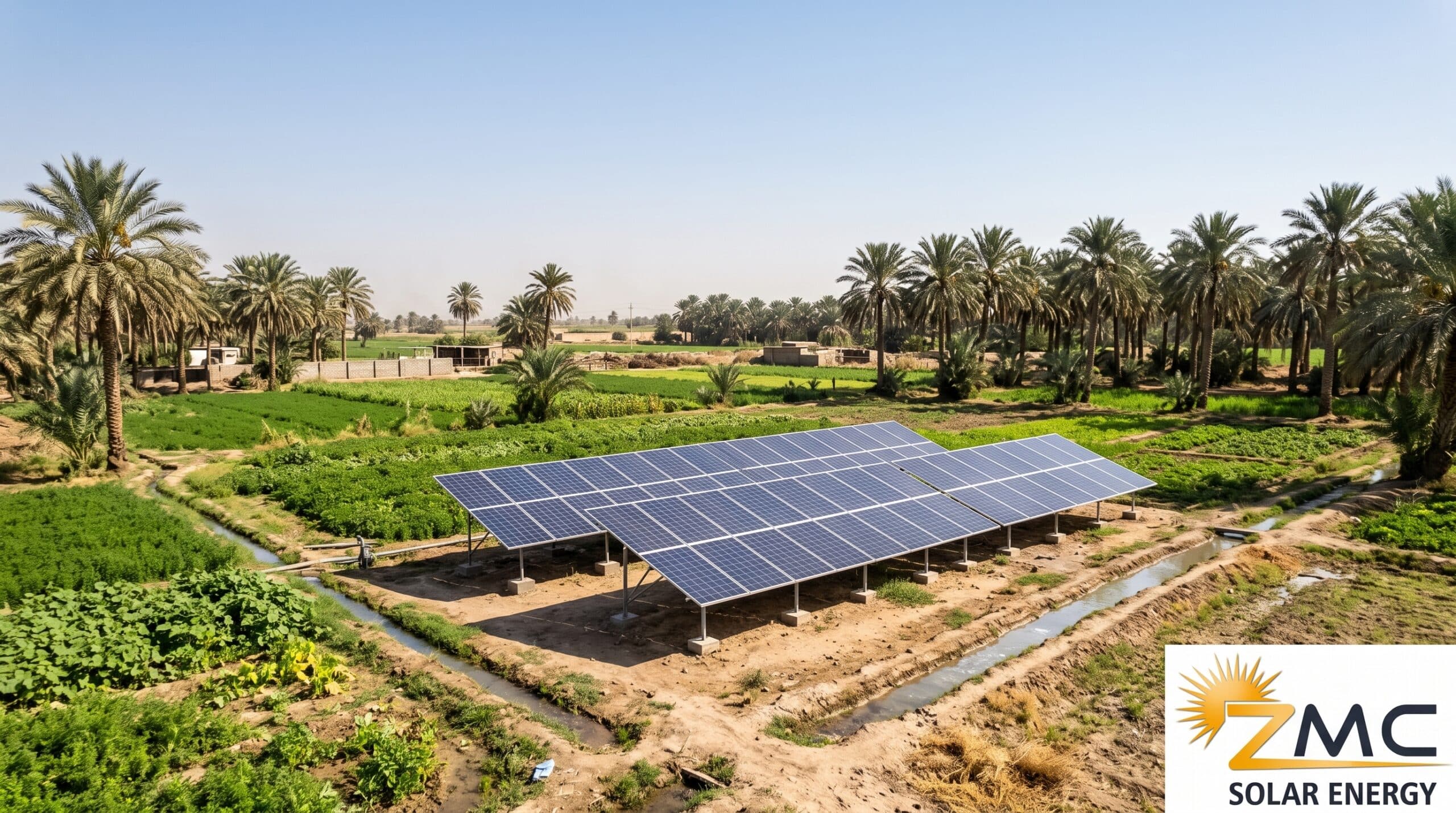
Every summer, Iraqi farmers face the same problem. Crops need the most water exactly when the grid is weakest and diesel bills are highest. Farm solar in Iraq solves that mismatch, because the sun is strongest on the same days your fields are thirstiest.
Today, more growers are replacing noisy generators with solar water pumps and ground-mounted panels. As a result, they cut fuel costs, irrigate on schedule and stop worrying about blackouts during the hottest weeks of the season.
In this guide, the ZMC Solar team explains how solar for farms works, which system suits your land, how to size a solar water pump, what it costs and how to keep panels productive in dust and extreme heat. Whether you grow wheat in Nineveh, dates in Basra or vegetables on the Erbil plains, you will finish with a clear, practical plan.
Why Farm Solar in Iraq Makes Sense Now
Three pressures meet on every Iraqi farm: expensive fuel, an unreliable grid and shrinking water supplies. Solar addresses all three at once.
Abundant Sunshine Across the Country
Iraq receives some of the strongest sunlight in the region. According to a 2026 engineering study from Tikrit University, average solar potential across the country sits at about 5.5 to 6.2 kWh per square metre per day. In practice, that means a well-designed array can run a pump for most of the daylight hours, nearly every day of the year.
However, the same study notes that diesel pumps still dominate Iraqi irrigation. Solar water pumping remains rare, largely because farmers lack locally adapted designs. In other words, early adopters still have a clear cost advantage over their neighbours.
Diesel Pumps Drain Cash Every Season
A diesel pump costs money every hour it runs. For example, one farmer featured by UNDP Iraq spent around US$700 a month on 10 barrels of diesel just to operate his well. After switching to a solar-powered well, that fuel bill disappeared.
In addition, generators need oil changes, spare parts and repairs. Fuel must be bought, transported and protected from theft. By contrast, a solar water pump has no fuel cost and very few moving parts.
An Unreliable Grid During Peak Irrigation
Grid power often fails when farms need it most. A Reuters report carried by Arab News describes wheat growers in Nineveh turning to solar to keep irrigation running through the summer heat. Farmers there use both rooftop panels and ground-mounted arrays on their land. Many still pay the electricity department only for night-time use, since their pumps run during the day.
Water Scarcity Rewards Efficient Pumping
Iraq is among the Middle Eastern countries most affected by water scarcity. Therefore, every litre you pump must count. Farm solar in Iraq pairs naturally with drip irrigation, which delivers water slowly over long daylight hours. One Iraqi agritech provider, Ainda Agricultural Center, reports that its solar-powered drip system can cut water use by 60 to 70 percent, depending on the crop.
How a Farm Solar System Works
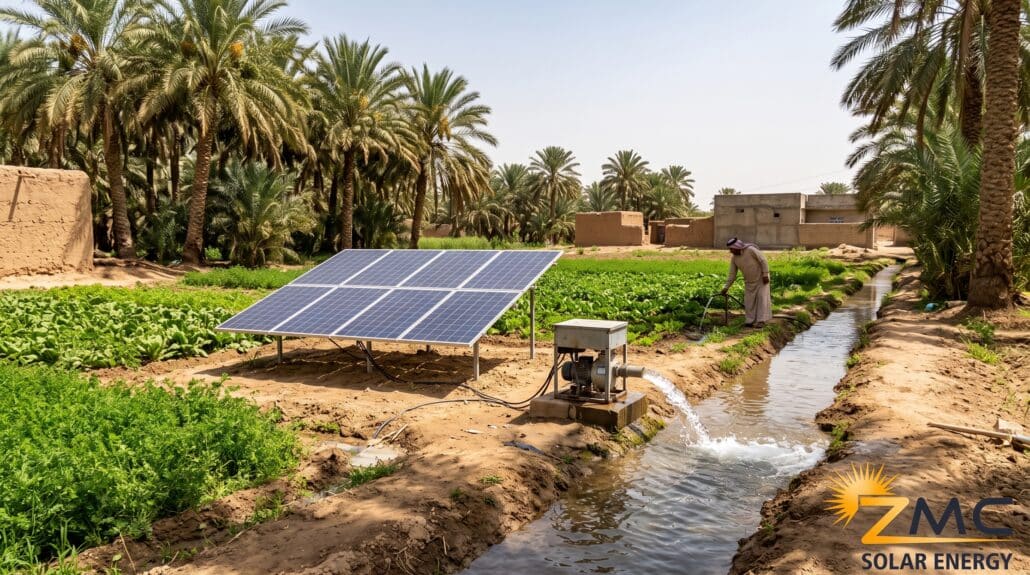
A farm solar system turns sunlight into pumping power, then delivers water straight to your fields or into a storage tank. The setup is simpler than most farmers expect. Here is the path from sunlight to soil:
- Solar panels: Capture sunlight and produce DC electricity. On farms, they usually sit on a ground-mounted steel frame close to the well or canal.
- A solar pump inverter: Also called a solar pump controller, it converts that power and adjusts the pump speed to match the available sunlight. As a result, the pump keeps working on hazy mornings instead of shutting down.
- The pump: Lifts the water. Submersible pumps suit boreholes and deep wells, while surface pumps suit rivers, canals and shallow ponds.
- A tank or irrigation network: Receives the water. You can feed drip lines and sprinklers directly, or fill an elevated tank for gravity-fed watering later.
- Optional batteries or a grid connection: Run night-time loads such as lighting, cold rooms, poultry fans or the farmhouse.
One principle saves farmers a great deal of money: store water, not electricity.
A water tank costs far less than a battery bank and lasts for decades. Therefore, most farm solar systems in Iraq pump during the day and store water for the evening.
Types of Solar Systems for Farms in Iraq
No single design fits every farm. The right choice depends on your water source, your distance from the grid and what else needs power. These four options cover almost every Iraqi farm.
| System Type | Best For | Batteries | Typical Loads |
|---|---|---|---|
| Off-grid solar water pump | Remote land, wells and locations without grid power | Usually none | Irrigation pump only |
| Hybrid farm system | Farms with a house, cold room or poultry shed | Yes, if night-time backup is needed | Pump plus day and night loads |
| On-grid farm system | Farms near reliable grid lines | Usually none | Pump and buildings, with grid power available at night |
| Large-scale agricultural solar | Big estates, greenhouses and processing facilities | Optional | Several pumps, cooling and machinery |
Off-Grid Solar Water Pumping
This is the most common form of solar irrigation in Iraq. Panels connect directly to a solar pump inverter, which drives the pump whenever the sun shines. There is no battery and no fuel, so running costs stay close to zero. It suits remote plots in Anbar, Salah Al-Din or the Kurdistan Region, where grid lines are far away. ZMC Solar designs these solar water pumping systems for irrigation, livestock and household water supply.
Hybrid Solar Systems for Farms
Many farms also need power after sunset, for example a farmhouse, a cold store for produce or ventilation fans in a poultry shed. A hybrid system adds a battery bank and a hybrid inverter, so the same array powers the pump by day and stored energy covers the night. Read our guide to hybrid solar systems in Iraq to see how these setups manage energy automatically.
On-Grid Solar for Farms Near the National Grid
If your farm sits close to stable grid lines, an on-grid system can be the cheapest option. Solar covers daytime pumping, while the grid supplies night-time needs. Not sure which approach suits you? Our article on the difference between on-grid and off-grid solar compares both in plain language.
Large-Scale Agricultural Solar Projects
Large estates, greenhouse complexes and agro-processing plants need engineered systems with several pumps and inverters. For these projects, ZMC Solar works as a solar EPC contractor in Iraq, handling engineering, procurement and construction from start to finish.
How to Size Farm Solar in Iraq: 5 Questions to Answer
Correct sizing is the difference between a system that works all season and one that disappoints by July. Before you request a quote, gather answers to these five questions.
- Where does your water come from, and how deep is it? Engineers call the total lift "head". A 120-metre borehole needs far more power than a canal pump lifting water 5 metres.
- How much water do you need each day? This depends on your crop, your planted area and your irrigation method. Drip irrigation needs much less water than flood irrigation.
- What pump power does that require? Head and daily volume together set the pump size. Farm pumps commonly range from about 1.5 kW (2 HP) to 37 kW (50 HP).
- How large should the solar array be? As a rule of thumb, installers size the array at roughly 1.3 to 1.5 times the pump motor power. This extra capacity helps the pump run during lower-light periods, although actual performance depends on system design and sunlight.
- What else needs power? List any cold rooms, lights, fans or household loads. These decide whether you need batteries or a grid connection.
A Simple Sizing Example
Consider a farm with a 5.5 kW (7.5 HP) submersible pump. Applying the rule above, the array would need about 7 to 8 kWp of panels. With modern 610–630 W modules, that works out to roughly 12 to 13 panels. However, treat this only as a starting point. Water depth, pipe length and your crop calendar can change the final design.
Need an accurate system design?
Book a solar system consultation. ZMC Solar engineers can assess your well, review your irrigation plan and size each component to match your requirements.
Farm Solar Cost in Iraq and How Fast It Pays Back
The price of a solar irrigation system depends on pump size, water depth, array size, mounting structure and whether you add batteries. For general reference, the Reuters report cited above put typical solar systems in Iraq at 5 to 10 million Iraqi dinars, with an average 5–6 kW system around 5 million dinars. Farm pumping systems can sit below or above that range, depending on the pump.
What You Stop Paying For
With farm solar in Iraq, the real question is not the price tag but the payback. Once installed, a solar water pump can reduce several recurring costs:
- Diesel or petrol for the pump and generator.
- Oil changes, filters and engine repairs.
- Fuel transport to remote plots.
- Crop losses caused by missed irrigation during blackouts.
- Grid bills for daytime pumping, where applicable.
A Simple Payback Formula
To estimate your payback period, divide the system cost by what you save each month:
For instance, take the UNDP farmer who spent about US$700 a month on diesel. That equals roughly US$8,400 a year in fuel alone. Your actual savings will depend on pump usage, fuel prices, maintenance costs and seasonal irrigation demand. A site-specific calculation is the best way to estimate the payback period.
Flexible Payment Options
Switching to solar is a significant investment. ZMC Solar offers flexible financing options on solar products, so contact our team to ask which plans currently apply to farm projects.
Choosing Farm Solar Equipment Built for Iraq's Climate
Iraqi farms test equipment harder than almost anywhere else. Summer temperatures pass 50°C, dust storms coat every surface and power cables lie exposed to sun all year. Therefore, cheap components rarely last. Focus on these five parts.
Tier-1 Solar Panels
Panels lose some output as they heat up, so choose modules with a strong temperature rating and a long performance warranty. ZMC Solar is the official distributor of Canadian Solar in Iraq, a Tier-1 brand built for high yields in demanding climates. In addition, high-wattage itel solar panels in the 610–630 W range reduce the number of modules, frames and connections your farm needs.
The Right Inverter for Each Job
Use a dedicated solar pump inverter for the irrigation pump, matched to the motor's power and voltage. For a farmhouse, cold room or office, an itel hybrid inverter such as the IPV-8K48U or IPV-12K48U manages solar, battery and grid power automatically. Meanwhile, farms with stable grid access can use itel on-grid inverters such as the IGT-12KTA or IGT-17KTA.
Batteries Only Where You Need Them
Remember the rule: store water, not electricity. Add batteries only for loads that must run at night. For those, itel lithium batteries or a DYQUE all-in-one storage system provide backup with reduced routine maintenance compared with many conventional alternatives.
Strong Mounting Structures
Ground-mounted frames should use galvanised steel, suitable foundations and enough clearance to keep panels above blown sand and standing water. Moreover, the tilt angle should suit your latitude and the season when you irrigate most.
Protection and Cabling
Finally, insist on UV-resistant solar cable, proper earthing and surge protection. These small items help protect your pump and inverter from lightning, voltage spikes and rodent damage. Learn how we test and select every component on our quality page.
Installing and Maintaining Farm Solar in Iraq
A good installation sets up decades of reliable pumping. Fortunately, the process is short and predictable.
The Installation Process
- Site survey: Engineers measure water depth, flow, pipe runs and available land for the array.
- System design: The team sizes panels, pump, inverter and any storage, then shares a clear quote.
- Installation: Technicians build the frame, mount the panels, wire the inverter and connect the pump.
- Commissioning and training: The system is tested under suitable operating conditions, and your farm staff learn the basic checks.
For a closer look at each stage, see our guide to solar panel installation in Iraq in 4 simple steps.
Simple Maintenance That Protects Your Output
Dust is the biggest enemy of farm solar in Iraq. A thin layer can noticeably reduce how much water your pump delivers. Fortunately, the fix is easy:
- Clean panels regularly during the dusty months and after significant dust storms.
- Use clean, soft water and a soft brush, ideally early in the morning when the panels are cool. Salty well water can leave deposits on the glass.
- Check cables, connectors and earthing every few months for damage from heat, animals or machinery.
- Watch the pump's daily water output. A sudden drop can signal dirty panels, a change in water levels or a pump problem.
- Keep weeds and crops trimmed so they never shade the array.
ZMC Solar also offers professional panel cleaning, inverter health checks and real-time remote monitoring through a mobile app. Ask the team which monitoring and maintenance services are available for your installation.
Frequently Asked Questions About Farm Solar in Iraq
Find answers to common questions about solar irrigation costs, pump sizing, batteries and installation across Iraq.
How much does farm solar cost in Iraq?
It depends mainly on pump size, water depth and whether you need batteries. General solar systems in Iraq have been reported in the 5 to 10 million Iraqi dinar range, but larger irrigation pumps and agricultural installations can cost more. Contact ZMC Solar for a quote based on your well and crops.
Can a solar water pump run without batteries?
Yes. Many solar irrigation systems run the pump directly from the panels during daylight. To water in the evening, pump into an appropriately sized elevated tank during the day and irrigate by gravity later, if your irrigation layout allows it.
Does solar irrigation work in winter and on cloudy days?
Yes, but output drops when sunlight is weaker. Pump performance depends on available sunlight, system sizing and water requirements. An appropriately sized array and water storage can help manage short periods of reduced sunlight.
How many solar panels do I need for a 7.5 HP pump?
A 7.5 HP (approximately 5.5 kW) pump may use around 7 to 8 kWp of solar panels as an initial estimate, or roughly 12 to 13 modules rated at 610–630 W. The final number depends on the pump specifications, water head, daily water demand and site conditions.
Can I keep my generator or grid connection?
Absolutely. Many farmers retain a generator or grid supply as backup. The appropriate system configuration determines how solar, batteries and backup power can work together. Confirm compatibility with your installer before connecting equipment.
Does ZMC Solar install farm systems outside Erbil and Baghdad?
ZMC Solar serves projects across Iraq. Contact the team to confirm installation availability and service coverage for your location, including Basrah, Mosul, Najaf and other governorates.
Start Your Farm Solar Project with ZMC Solar
Farm solar in Iraq is no longer an experiment. It is a practical way to cut fuel bills, irrigate on time and protect your harvest from blackouts. Moreover, the strong Iraqi sun makes solar pumping an attractive option for many farms.
ZMC Solar brings equipment from Canadian Solar, itel and DYQUE together with local engineering, installation and after-sales support. From a single well pump to a full agricultural estate, we design each system around your water, your crops and your budget.
Learn more about ZMC Solar and our work across the country.