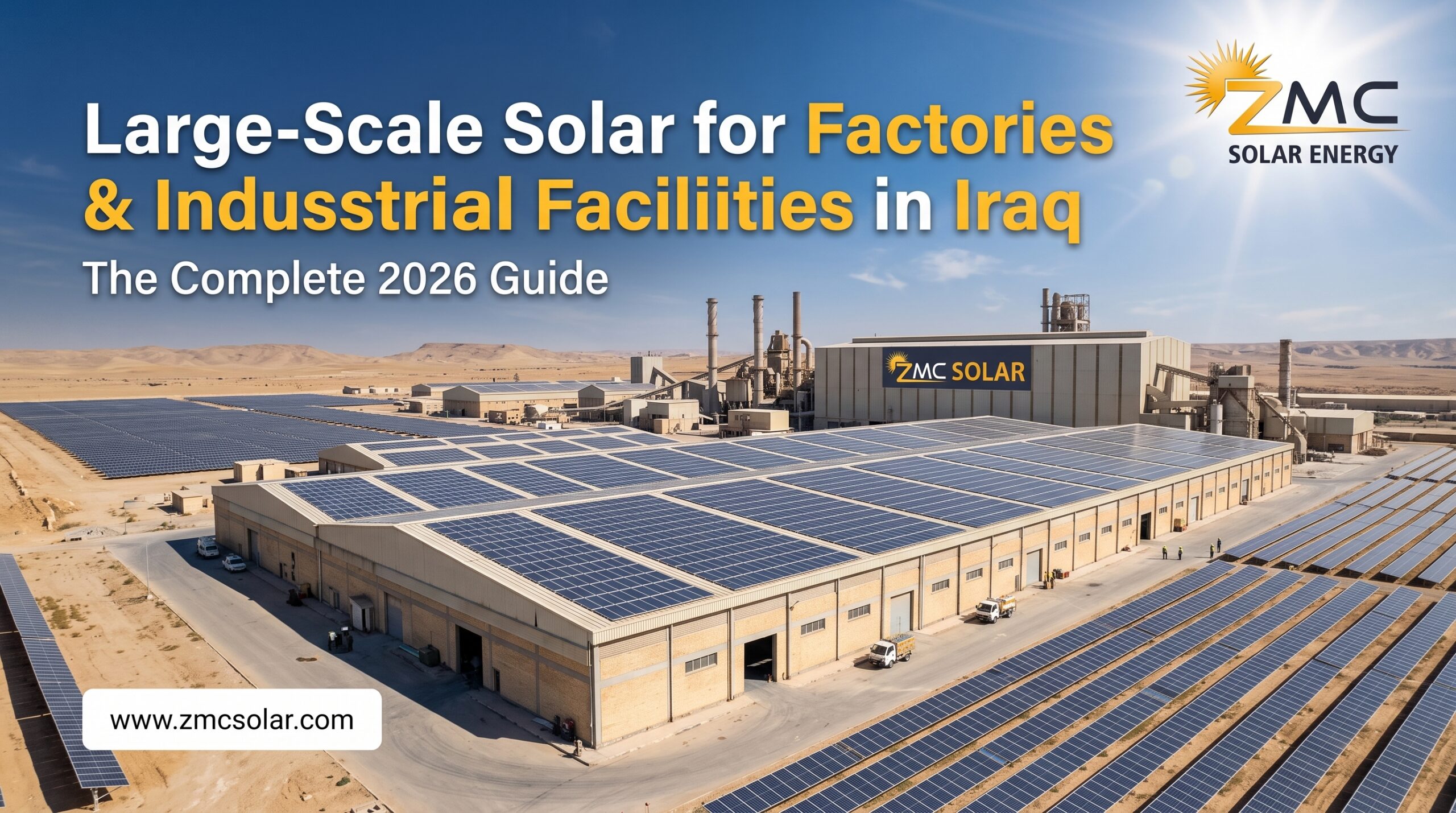
Large-Scale Solar for Factories & Industrial Facilities in Iraq: The Complete 2026 Guide
Iraq's factories are operating under conditions that would shut down a business anywhere else in the world. As of summer 2026, the national grid carries an 11,000-megawatt deficit — demand hits roughly 40 GW at peak while supply struggles to reach 29 GW. In central provinces like Najaf, Karbala, and Babil, factories endure up to 12 hours of daily blackouts, often during 50°C summer heat when production lines, refrigeration systems, and air conditioning are running hardest. The answer isn't more diesel. It's large-scale solar — and the economics in Iraq are now better than almost anywhere on earth. This guide covers everything a factory owner, operations director, or procurement manager needs to know: system types, costs, ROI timelines, sector-specific benefits, government incentives, and how to choose the right EPC partner to deliver the project.
Why Iraq's Factories Can't Afford to Ignore Solar in 2026
Iraq's electricity problem is not new, but 2026 has made it significantly worse. The disruption to Iranian gas imports — which previously supplied up to 30 million cubic meters per day to Iraqi power stations — reduced that supply by over 80%, removing a critical fuel source that generators across the country depended on. The knock-on effect for factories has been severe.
When the grid cuts out, factories face a binary choice: run on diesel generators at enormous cost, or shut down production entirely. Neither is acceptable. Diesel in Iraq currently costs between $0.35 and $0.65 per litre at commercial rates, and a mid-sized factory running a 500 kW generator for 10 hours burns through roughly 1,200 litres per day — a daily fuel bill that can exceed $700 before a single unit of productive output is made.
Solar eliminates that cost entirely. Iraq sits in one of the world's highest-irradiance zones, receiving approximately 3,250 sunshine hours per year and an annual solar yield of around 1,159 kWh per installed kilowatt-peak (kWp). According to the IRENA 2023 Renewable Power Generation Costs Report , industrial solar generation costs in high-irradiance regions like Iraq average just $40-$45/MWh compared to $120/MWh or more for fossil-fuel alternatives — roughly one-third the cost of the diesel currently burning in Iraqi factory generators.
Learn how ZMC Solar structures complete commercial projects from feasibility to commissioning — Commercial Solar Energy Company in Iraq
How Much Power Does an Iraqi Factory Actually Need?
Before designing any system, the starting point is always a load assessment — an accurate picture of the facility's electricity consumption by hour, by season, and by production shift. Getting the system size wrong means either overpaying for unused capacity or running short during peak demand.
Small Factories and Workshops (50 kW - 200 kW peak demand)
Textile workshops, small food processing units, tile manufacturers, and light assembly lines. A 60-180 kWp solar array typically covers 60-80% of daytime consumption. These projects complete in two to six weeks and achieve the fastest paybacks.
Medium Industrial Facilities (200 kW - 1,000 kW peak demand)
Pharmaceutical plants, dairy processing facilities, cold storage warehouses, concrete and block manufacturing, and mid-scale steel workshops. Systems in this range run from 200 kWp to 1 MWp and require sophisticated inverter configurations and battery storage to manage load spikes.
Large Industrial Complexes (1 MW - 5 MW+ peak demand)
Cement plants, major food processing factories, large logistics and refrigeration hubs, auto parts manufacturing, and heavy industrial facilities. These are full EPC projects requiring detailed engineering surveys, utility-scale inverters, three-phase integration, and a custom grid interconnection agreement.
Three-Phase Power: The Critical Industrial Requirement
Most industrial machinery in Iraq operates on a three-phase 380V/400V supply, not the single-phase 220V used in homes. Large-scale factory solar systems require three-phase string inverters capable of delivering balanced three-phase output — essential for motors, compressors, pumps, and CNC equipment. Any contractor proposing a factory system without addressing three-phase integration should be disqualified immediately.
What Does a Large-Scale Industrial Solar System Include?
Solar PV Array — Tier-1 monocrystalline panels rated at 550 Wp-700 Wp each. For a 500 kWp system, that means roughly 715-900 panels covering 2,800-4,000 m² of roof or ground area. High-temperature performance matters enormously in Iraq, making module selection a critical engineering decision, not just a price comparison.
Industrial Inverters — Central or string inverters rated for three-phase output, with IP65 or higher weatherproofing for Iraq's dust and heat conditions. Systems above 100 kWp use multiple string inverters in parallel, sized with redundancy so a single failure does not halt production.
Battery Storage — For Iraqi factories, battery storage is not optional. Without it, solar generation stops the moment the grid cuts out. A battery bank covering four to eight hours of critical loads lets production continue through outages and into evening shifts.
Compare battery options sized for Iraq's industrial load and temperature range — Industrial-Grade Solar Battery Storage in Iraq
Monitoring and SCADA — Real-time production monitoring, fault detection, and data logging. A proper monitoring system gives facility managers visibility into generation, consumption, battery state, and grid export from a single dashboard.
Cabling, Switchgear, and Protection Systems — Often undercosted by inexperienced contractors. Industrial systems require DC cabling, AC circuit breakers, surge protection, DC isolators, anti-islanding protection, and a dedicated metering arrangement for grid-tied projects.
Mounting Structures — Rooftop, ground-mount, or carport configurations depending on available space. Industrial roofs in Iraq are typically flat concrete or ribbed metal sheeting; both are viable, but structural load calculations are mandatory before installation.
Industrial Solar Costs in Iraq: What to Budget in 2026
Solar panel prices have fallen to historic lows, and Iraq's reduced import tariffs on solar equipment mean those savings pass directly to the buyer. As a general benchmark for 2026:
| System Size | Typical Factory Type | Cost per kWp (Installed) | Estimated Total Cost |
|---|---|---|---|
| 50-200 kWp | Small workshop, light assembly | $350-$550 | $17,500-$110,000 |
| 200 kWp - 1 MWp | Pharmaceutical, cold storage, concrete | $300-$450 | $60,000-$450,000 |
| 1 MWp+ | Cement, heavy industrial, logistics | $250-$380 | $250,000+ |
Cost Comparison: Solar vs. Diesel vs. Grid
| Energy Source | Approx. Cost per kWh | Notes |
|---|---|---|
| Industrial Solar (25-yr LCOE) | $0.04-$0.06 | Near-zero fuel cost after installation |
| Diesel Generator | $0.28-$0.45 | Fuel + maintenance + depreciation |
| Iraq Commercial Grid | $0.046 | Unreliable; 12+ hour outages daily |
| Fossil Fuel Power (utility-scale) | $0.12 | Iraq's own generation cost benchmark |
Financing Available: The Central Bank of Iraq has allocated $850 million in subsidised loans for renewable energy installations. The National Investment Commission licenses qualifying projects under a 10-year tax exemption framework. Import duties on panels and inverters have also been significantly reduced — cutting procurement costs for large commercial buyers.
ROI and Payback Period for Factory Solar in Iraq
European factories typically achieve solar payback in five to eight years. In Iraq, the combination of high irradiance, high diesel costs, and minimal grid reliability pushes that figure down to three to five years for most installations.
Worked Example: 500 kWp System
Annual generation: 500 kWp x 1,159 kWh/kWp = 579,500 kWh/year
Diesel avoided at $0.35/kWh: $202,825 saved per year
Installation cost at $375/kWp: $187,500
Simple payback: 187,500 / 202,825 = approximately 11 months
Payback by Industry Sector
| Sector | Typical Payback | Key Driver |
|---|---|---|
| Cold Storage / Food Processing | 3.5-5 years | High 24/7 refrigeration loads |
| Textile and Garment | 3-4 years | Daytime shifts align with solar peak |
| Concrete and Building Materials | 4-5 years | Heavy three-phase motor loads |
| Pharmaceuticals | 4-6 years | High uptime and clean power requirement |
| Logistics and Warehousing | 4-5 years | Large roof area; forklift charging |
On-Grid, Off-Grid, or Hybrid? Choosing the Right System for Your Factory
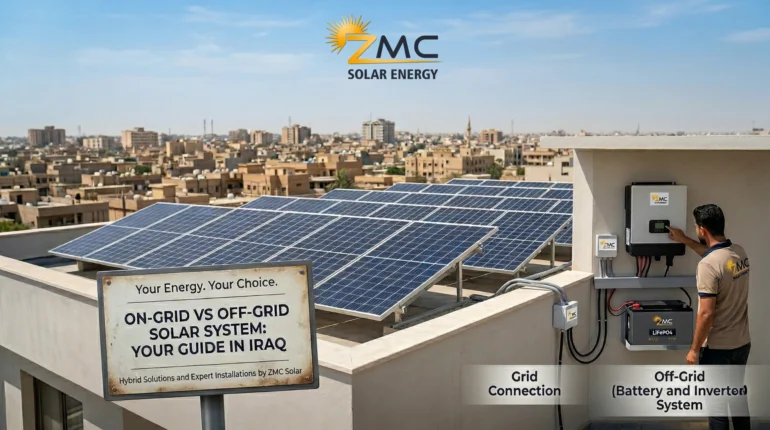
On-Grid (Grid-Tied) Solar is the cheapest to install but has a critical flaw for Iraq: when the grid cuts out, on-grid systems automatically shut down for safety. A factory loses all solar power precisely during the worst outages. Not recommended as a standalone solution for Iraqi factories.
Off-Grid Solar operates entirely independently of the national grid — ideal for factories in remote areas away from established distribution infrastructure. It requires a larger battery bank but delivers complete energy independence.
Hybrid Solar is the recommended configuration for the vast majority of Iraqi factories. Solar is the primary source, batteries store surplus, the grid supplements when available, and the battery covers outages — switching in under 20 milliseconds, imperceptible to production equipment.
Full technical comparison of on-grid, off-grid, and hybrid configurations — On-Grid vs Off-Grid Solar Systems in Iraq
See how a hybrid system manages solar, battery, and grid simultaneously — Hybrid Solar Systems in Iraq: 2026 Guide
Solar by Factory Type: Which Industrial Sectors Benefit Most
Food Processing and Cold Storage
Food factories and cold chain facilities have the highest electricity demands and the least tolerance for power interruptions. A refrigeration system that loses power even briefly risks product spoilage and compliance failures. Solar with battery storage cuts electricity cost and eliminates the power gap that currently forces most cold storage operators to run diesel generators 24/7.
Cement, Concrete, and Construction Materials
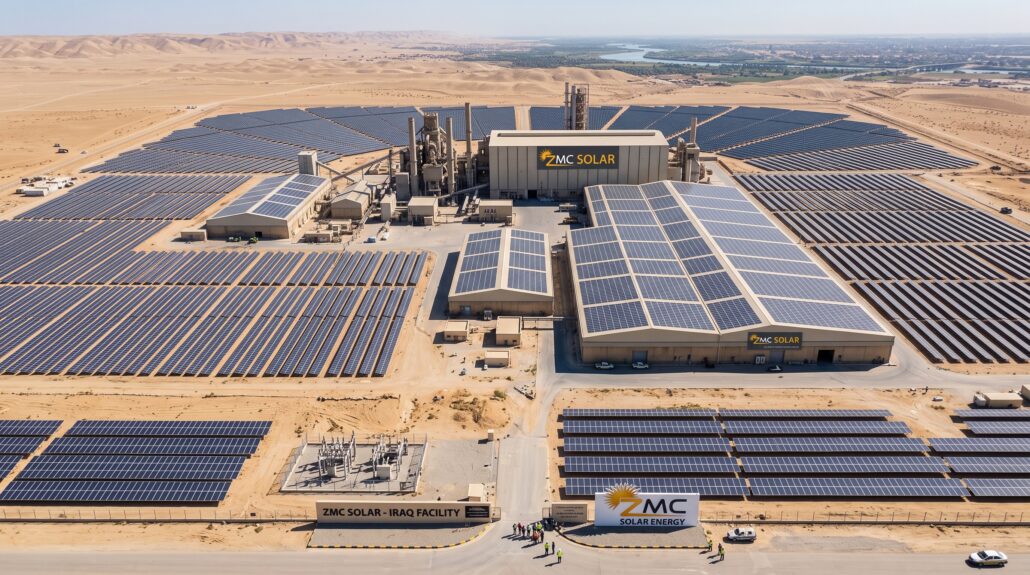
Heavy three-phase motors power cement mixers, block presses, conveyor systems, and stone crushers. These facilities often have large, flat rooftops ideal for high-density solar arrays. Many plants have enough roof area to cover 80-100% of daytime production loads.
Textile and Garment Manufacturing
Sewing, weaving, and textile printing facilities run multiple machines simultaneously during daylight hours — a load profile that maps almost perfectly onto solar generation. Air conditioning is a major cost in Iraqi summer; solar peaks exactly when AC demand is highest.
Pharmaceuticals and Medical Manufacturing
GMP-compliant production requires stable, clean power. Generators introduce voltage irregularities that disrupt sensitive analytical equipment. A solar-hybrid system with a pure-sine-wave inverter delivers cleaner power than either the grid or a generator.
Water Treatment and Industrial Pumping
Large pump motors running for extended hours are predictable loads that map directly onto solar generation windows. Pumping applications carry some of the simplest engineering and fastest payback of any industrial solar installation.
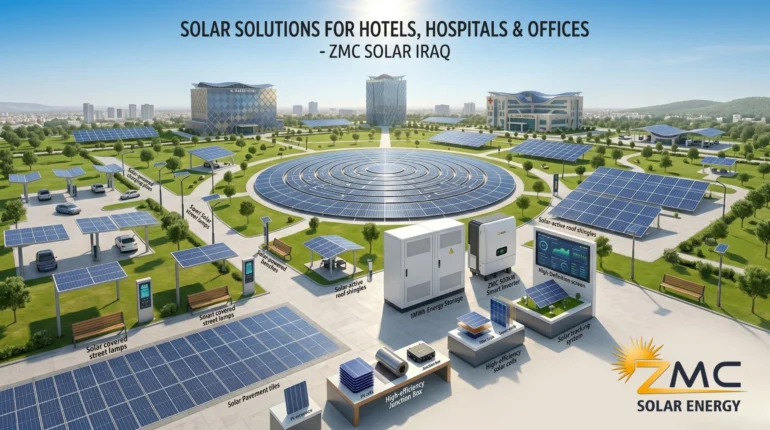
ZMC Solar also delivers large-scale solar for hotels, hospitals, offices, and schools — Solar Solutions for Hotels, Offices and Schools in Iraq
Iraq's Solar Policy Support for Industrial Projects in 2026
Central Bank Solar Loan Programme: $850 million in subsidised financing for renewable energy installations. Industrial and commercial entities are eligible through participating commercial banks, with preferential rates and extended repayment terms.
10-Year Tax Exemptions: Projects licensed by the National Investment Commission under the renewable energy framework receive a 10-year exemption from corporate income tax attributable to the project.
Reduced Import Tariffs: Panels, inverters, mounting systems, and storage equipment imported for renewable energy projects now carry significantly reduced tariff rates, directly lowering procurement costs for large-scale installations.
Iraq's 2030 Renewable Energy Target: Iraq aims for 12 GW of installed renewable capacity by 2030, representing 33% of total electricity supply. Only approximately 42 MW is currently installed — meaning the government must approve an enormous volume of commercial and industrial solar projects over the next four years. Factory owners who act now benefit from the strongest policy tailwind this market has ever seen.
How to Choose a Solar EPC Contractor for Your Factory in Iraq
Engineering, Procurement, and Construction (EPC) is the turnkey solar project delivery model — one company manages everything from feasibility study to commissioning. For industrial projects, EPC is the only responsible approach. Selecting the wrong contractor is the most common source of industrial solar project failures.
Documented industrial project experience. Ask for a portfolio of completed factory, warehouse, or manufacturing facility projects specifically — not residential jobs. Request commissioning reports and client references you can contact directly.
In-country engineering teams. Iraq's construction environment requires engineers who understand local structural standards, grid interconnection procedures, and on-site logistics. Remote engineering introduces unnecessary risk on a multi-hundred-thousand-dollar project.
Tier-1 equipment only. Tier-1 is a financial classification reflecting the manufacturer's ability to honour warranties. For a system expected to operate for 25 years, it is the minimum acceptable standard — not a premium option.
ZMC Solar is an authorised distributor of Canadian Solar — one of the world's top three Tier-1 manufacturers — Canadian Solar Panels in Iraq
Local spare parts availability. Industrial systems cannot wait weeks for a replacement inverter to arrive from overseas. Verify your contractor maintains local stock of critical spare parts and has service engineers available for on-site response.
Transparent, itemised proposals. A professional EPC contractor provides a line-by-line breakdown of every cost: panels, inverters, batteries, mounting, cabling, labour, civil works, commissioning, and warranty terms. Lump-sum quotations without itemisation conceal where corners may be cut.
ZMC Solar's full engineering, procurement, and construction process for large-scale industrial projects in Iraq — Solar EPC Contractor in Iraq
Frequently Asked Questions
Ready to Stop Paying for Diesel?
Iraq's power crisis is not resolving in the short term. ZMC Solar's engineering team covers Baghdad, Erbil, Basra, Sulaymaniyah, Mosul, Kirkuk, and all surrounding provinces. Book a no-obligation site assessment and get a full ROI projection for your facility.
Book a Free Factory Solar Consultation