Solar Energy for Shops and Businesses in Iraq: Full Cost and ROI Guide (2026)
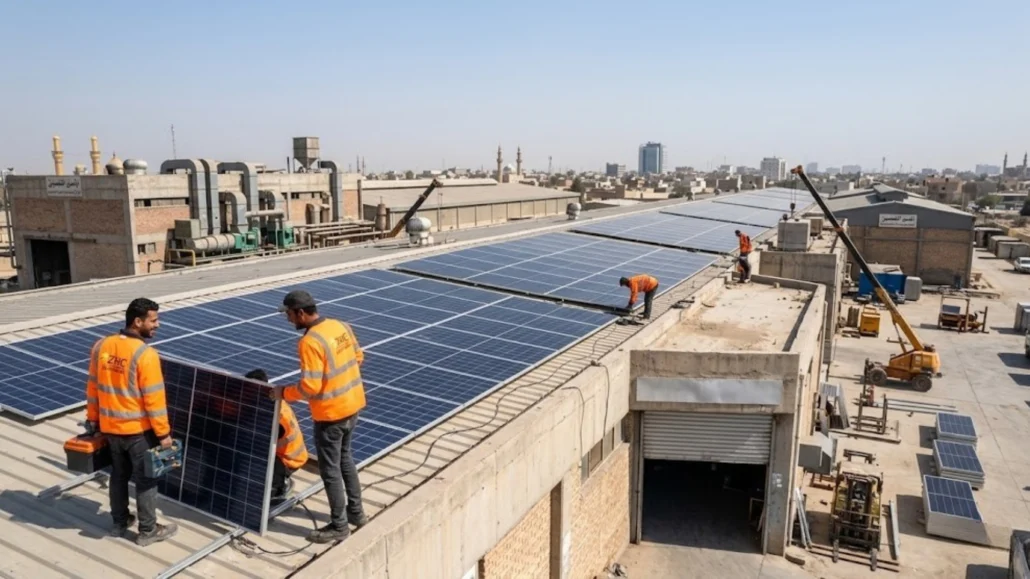
Every shop, restaurant, hotel, and factory in Iraq has the same problem. We have brought you the solution. Solar energy for Shops and Businesses in Iraq.
The national grid does not provide enough power. Businesses run their air conditioners, lighting, and equipment on diesel generators. And generators are expensive. Fuel costs money every day. Maintenance costs money. The noise and pollution affect customers and staff.
Solar energy changes all of this.
In 2026, thousands of businesses across Iraq are switching to solar. They are cutting their generator costs by 70% or more. They are getting clean, reliable power from the sun — which Iraq has more of than almost anywhere else on earth.
This guide gives you the full picture. How much does a commercial solar system cost in Iraq? What is the return on investment (ROI)? How fast does it pay back? And what do businesses in different sectors need to know before they start?
Why Commercial Solar Makes Sense in Iraq in 2026
Iraq receives between 2,800 and 3,000 hours of sunlight every year. This is one of the highest rates in the world. It means solar panels in Iraq produce more electricity per panel than in most other countries.
At the same time, Iraq’s electricity crisis has not been solved. The national grid can only supply around 27,000 megawatts of power. Demand reaches 50,000 megawatts in summer. The gap is enormous. Businesses fill that gap with generators — and that is exactly where solar can replace them.
Three things changed in 2026 that make now the best time to go solar:
1. Import tariffs on solar equipment dropped to 5%. Before 2026, importing solar panels into Iraq carried customs duties as high as 33%. The government cut this to just 5%, making quality solar equipment significantly cheaper.
2. The Central Bank of Iraq launched a solar loan programme. The Central Bank has set aside 6 trillion Iraqi Dinars for solar loans. Banks including Cihan Bank and Rasheed Bank are offering loans to businesses and homeowners for solar systems. This means you can install a commercial solar system without paying the full cost upfront.
3. Solar panel prices globally are at record lows. Panel prices have fallen dramatically over the last decade. In 2026, quality commercial solar panels cost significantly less per watt than they did five years ago, making the return on investment faster than ever.
How Much Does a Commercial Solar System Cost in Iraq?
The cost depends on the size of the system. Size is measured in kilowatts (kW). Larger businesses need larger systems.
| Business Type | Recommended System Size | Estimated Cost (USD) | Estimated Cost (IQD) |
|---|---|---|---|
| Small shop or salon | 3–5 kW | $2,500–$4,500 | IQD 3.2M–5.9M |
| Restaurant or café | 5–10 kW | $4,500–$8,500 | IQD 5.9M–11.1M |
| Medium retail shop | 10–20 kW | $8,500–$16,000 | IQD 11.1M–20.9M |
| Hotel or guesthouse | 20–50 kW | $16,000–$38,000 | IQD 20.9M–49.6M |
| Factory or warehouse | 50–200 kW | $38,000–$140,000 | IQD 49.6M–182M |
Prices include panels, inverter, mounting, wiring, and installation. Battery storage is additional.
These prices are estimates for quality systems using certified panels such as Canadian Solar, itel, or DYQUE, brands that ZMC Solar distributes directly in Iraq with full warranty support.
What Is Included in a Commercial Solar System?
A complete commercial solar installation has several parts. Every part is important.
Solar panels — These collect sunlight and convert it into electricity. The number of panels depends on your system size. A 10 kW system typically uses 20 to 25 panels.
Inverter — This converts the electricity from the panels into the type your business equipment can use. For commercial systems, a hybrid inverter is usually the best option because it can work with both solar panels and batteries.
Battery storage (optional but recommended) — Batteries store excess solar energy for use at night or during cloudy periods. Lithium batteries are the best choice for commercial systems in Iraq. They last longer and perform better in high temperatures than older battery types.
Mounting structure — This holds the panels in place on your roof or on the ground. All ZMC Solar installations use weather-rated structures built for Iraq’s climate.
Cabling and protection equipment — All electrical connections, fuses, and safety switches that protect the system.
Monitoring system — Allows you to track how much power your system produces and how much you are saving, usually through a phone app.
How to Calculate Your ROI and Payback Period
ROI stands for return on investment. It tells you how profitable the solar system is over its lifetime.
The payback period is simpler. It is the number of years until your solar system has saved you enough money to cover its own cost. After that point, all savings go straight to your profit.
Here is how to think about it for an Iraqi business:
Step 1: Calculate your current generator cost. Most businesses in Iraq spend between $300 and $1,500 per month on generator fuel and maintenance. That is $3,600 to $18,000 per year.
Step 2: Calculate how much solar will save you. A well-sized solar system can eliminate 70% to 100% of your generator running time during daylight hours. A restaurant spending $800 per month on generators could save $560 to $800 every month — between $6,700 and $9,600 per year.
Step 3: Divide the system cost by annual savings. A 10 kW system for that restaurant costs around $8,500. If it saves $7,500 per year, the payback period is just over one year.
Real example — small shop in Baghdad:
A mobile phone accessories shop in Baghdad was spending $350 per month on a generator subscription and fuel. After installing a 5 kW solar system costing $4,200, the shop reduced its generator use by 80%. Monthly savings: $280. Payback period: 15 months. After that, the shop saves $3,360 per year — for the next 24 years. That is over $80,000 in lifetime savings from one $4,200 investment.
Solar ROI by Business Type in Iraq
Different businesses have different electricity needs. Here is a breakdown of realistic ROI scenarios:
Shops and Retail Stores
A small to medium shop in Iraq typically needs a 3 to 10 kW system. These shops are open during daylight hours, which means they can use almost all the solar power produced in real time — this maximises savings.
A retail shop spending $400/month on generators with a 7 kW system ($6,000 cost) can expect:
- Monthly savings: $300–$350
- Payback period: 18–20 months
- Lifetime savings (25 years): $90,000+
Restaurants and Cafés
Restaurants have high electricity demand. Air conditioning, refrigeration, cooking equipment, and lighting all run simultaneously. A restaurant needs a 10 to 30 kW system depending on size.
A café spending $900/month on generator costs with a 15 kW system ($12,500 cost) can expect:
- Monthly savings: $600–$750
- Payback period: 17–21 months
- Lifetime savings (25 years): $180,000+
Hotels and Guesthouses
Hotels are one of the best use cases for commercial solar in Iraq. They run electricity all day and night. A hybrid solar system with battery storage means the hotel stays powered even when the sun goes down.
A small hotel spending $2,500/month on generators with a 30 kW solar + battery system ($28,000 cost) can expect:
- Monthly savings: $1,600–$2,000
- Payback period: 14–18 months
- Lifetime savings (25 years): $480,000+
Factories and Warehouses
Large commercial and industrial operations have the highest electricity demand and the highest generator costs. They also benefit most from solar because they operate during daylight hours when solar production is at its peak.
A factory spending $5,000/month on power costs with a 100 kW system ($75,000 cost) can expect:
- Monthly savings: $3,000–$4,000
- Payback period: 19–25 months
- Lifetime savings (25 years): $900,000+
The Generator Problem: Why Solar Is the Real Solution
Iraq has around 3,000 hours of sunlight per year. It has enough solar radiation to power the entire country many times over. Yet most businesses are still running diesel generators — machines that burn money every single day.
A generator is not an investment. It is a recurring cost with no end.
Every litre of diesel you buy is money gone. Every service, oil change, and repair is money gone. The generator will break down. It will need to be replaced. And through all of this, your generator bill never gets smaller.
Solar is the opposite. You pay once. The sun does the work for 25 to 30 years. The panels do not burn fuel. They do not break down often. Quality panels from brands like Canadian Solar lose less than 0.5% of their power output per year. After 25 years, your panels still produce over 85% of their original power.
The business case is clear: solar is not an expense. It is the last energy investment your business needs to make.
How Iraq’s New Policies Support Commercial Solar in 2026
The Iraqi government has made solar easier and cheaper to adopt this year.
Customs duties cut to 5%. This is the biggest single policy change for the solar market in Iraq. Before March 2026, importing solar panels carried 33% import duties. Now it is 5%. This directly reduces the upfront cost of any commercial solar installation.
Central Bank solar loan programme. The Central Bank of Iraq has made 6 trillion Iraqi Dinars available for solar loans. This is a direct financing programme for homes and businesses. You do not need to pay the full system cost upfront. You can borrow through partner banks and repay over time while your monthly savings from solar cover the instalments.
Government solar targets. Iraq’s government has set a target of 12 gigawatts of solar capacity by 2030. This means the solar ecosystem — supply chains, trained installers, available equipment — is growing rapidly across all provinces.
Choosing the Right Solar Company in Iraq
Not all solar companies in Iraq offer the same quality. Here is what to look for before you sign a contract.
Certified brand partnerships. Make sure the company sells certified panels from trusted manufacturers. ZMC Solar is an authorized distributor of Canadian Solar, itel Solar, and DYQUE in Iraq. These brands come with international manufacturer warranties.
Experience with commercial installations. Ask to see examples of completed commercial projects. A company that only does residential work may not have the experience for a factory or hotel installation.
Post-installation support. Your solar system needs to work for 25 years. What happens if a panel fails in year three? Does the company offer monitoring, maintenance, and warranty support?
Branches near your location. ZMC Solar operates from Erbil and Baghdad, with the ability to install across all Iraqi provinces. Local presence means faster response times for support.
Transparent pricing. A reliable solar company will give you a detailed quote. Every item — panels, inverter, batteries, installation, cabling — should be itemised. No hidden fees.
ZMC Solar Best Solar Company in Iraq, Erbil, Baghdad
Businesses in Iraq are losing money every month to generators. The fuel bills, maintenance costs, and breakdowns are a constant drain on profit.
Solar energy ends that. One investment. One installation. And then 25 years of clean, free power from the sun — with Iraq getting more sunlight than almost anywhere else on the planet.
The ROI for commercial solar in Iraq is exceptional. Most businesses recover their investment in under two years. After that, every dirham saved on energy becomes profit.
With solar import tariffs now at just 5%, Central Bank loans available, and quality certified brands like Canadian Solar and itel accessible through ZMC Solar, there has never been a better time to make the switch.
$2,500 for a 3 kW shop system up to $140,000 for a 200 kW industrial system. Cost depends on size, panels, and batteries. Free quote from ZMC Solar.
Most businesses recover their investment in 12 to 24 months — faster than average due to high generator costs and Iraq’s excellent solar irradiance.
Yes. A 3 kW AC unit needs a 5–7 kW solar system to run alongside other loads. Add battery storage to keep it running after sunset.
Panels last 25–30 years. Canadian Solar and itel include a 25-year warranty. Inverters last 10–15 years. Lithium batteries last 8–12 years.
Yes. The Central Bank of Iraq has set aside IQD 6 trillion for solar loans, available through Cihan Bank and Rasheed Bank. Install now, repay in instalments.
ZMC Solar distributes Canadian Solar, itel Solar, and DYQUE, all internationally certified and tested for Iraq’s high-temperature climate.
Yes. Import tariffs dropped from 33% to 5% in 2026. Iraq also targets 12 GW of solar capacity by 2030, backed by public and private investment.
Visit zmcsolar.com or our offices in Erbil or Baghdad. We assess your usage, recommend the right system, and provide a full itemised quote at no cost.