On-Grid vs Off-Grid Solar System: Which One is Best for Your Home or Residential Project in Iraq?
Are you tired of power cuts? In Iraq, keeping the lights on can be hard. Many families use loud generators that cost a lot of money. But now, there is a better way. Solar energy is becoming very popular across the country. It uses the sun to give you free electricity. Let’s check between On-grid and Off-grid solar system for your need.
When you look for solar solutions for homes in Iraq, you will see two main choices. These are “On-Grid” and “Off-Grid” systems. You might also hear about “Hybrid” systems. Each one works in a different way.
This guide will explain the difference between on grid and off grid solar. We will help you find the best residential solar systems in Iraq for your family. By the end, you will know how to save money and stay powered up all day and night.
What is an On-Grid Solar System?
An on-grid solar system is the most common type. It connects your home directly to the national electricity lines. Most people in big cities like Baghdad or Erbil start by looking at this option.
How On-grid solar system works?
Your solar panels sit on your roof. They catch sunlight and turn it into power. This power goes into your home first. If you make more power than you need, the extra goes back into the city’s power lines.
Why People Like On-Grid
Lower Cost
These systems are cheaper because you do not need to buy big batteries.
Simple Setup
It is easy to install and easy to look after.
Save on Bills
You use less electricity from the government, so your bill goes down.
The Problem in Iraq
There is one big thing to know about the difference between on grid and off grid solar system setups. An on-grid system must turn off if the national power goes out. This is a safety rule. Since Iraq has many power cuts, an on-grid system alone might leave you in the dark when the grid fails.
What is an Off-Grid Solar System?
An off-grid system is like your own private power station. It is not connected to the national power lines at all. You are 100% independent.
How Off-Grid Works
Since you are not connected to the grid, you need a way to store power for the night. This system uses a large “battery bank.” During the day, the sun charges the batteries. At night, you run your lights, fridge, and AC using that stored energy.
For whome it is for?
This is one of the best solar solutions for homes in Iraq if you live in a remote area. If the national power lines do not reach your house or farm, off-grid is the way to go. It is also great for people who never want to rely on the government or “mowlida” (private generators) again.
The Main Challenge with Off-Grid solar system
Batteries can be expensive. To have enough power for a whole house in the summer, you need high-quality batteries. This makes the starting cost higher than an on-grid system.
Key Differences Between On-Grid and Off-Grid Solar
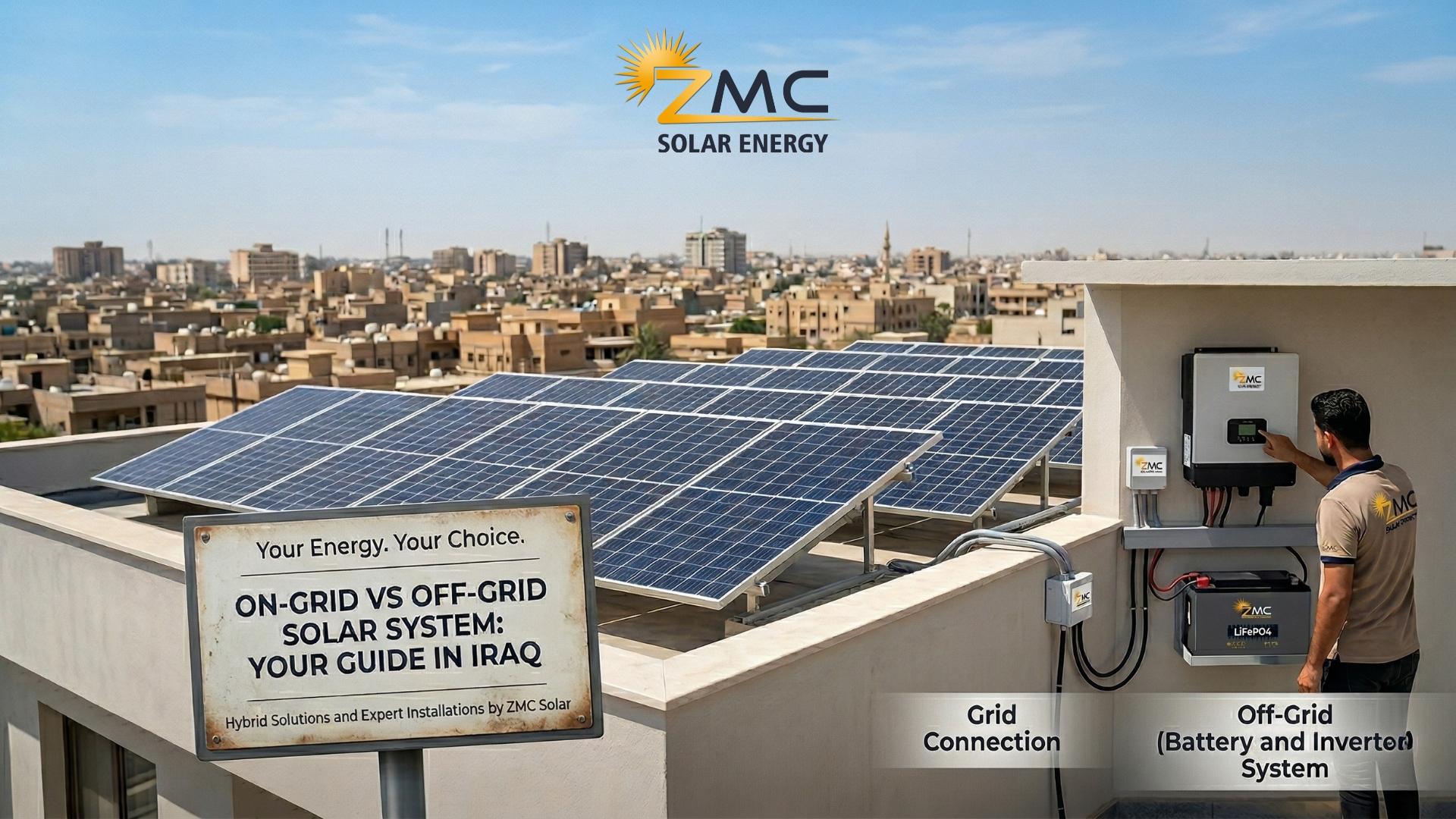
To help you choose, let’s look at the main difference between on grid and off grid solar in a simple way.
Feature
Grid Connection
Batteries
Power Cuts
Setup Cost
Independence
On-Grid System
Yes, connected to the city power.
Usually no batteries.
Stops working when the grid fails.
Cheaper to start.
Still rely on the grid.
Off-Grid System
No, it is totally separate.
Needs a big battery bank.
Works all the time.
More expensive to start.
Total energy freedom.
Which Solar System is Best for Your Home in Iraq?
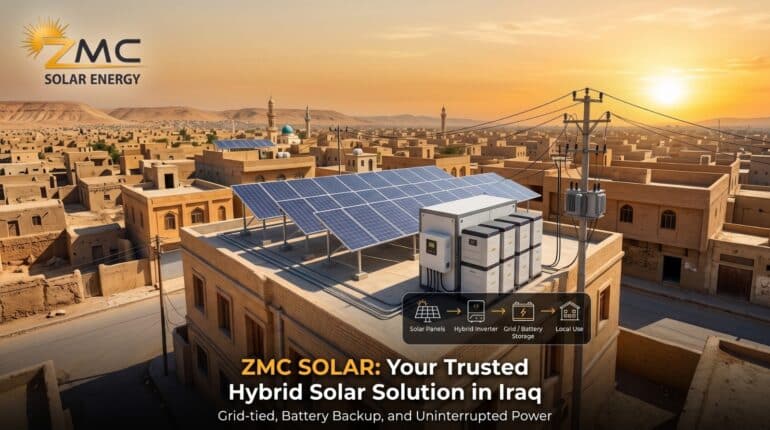
If you are asking which solar system is best for home in Iraq, the answer is usually a mix of both. This is called a hybrid solar system.
Why Hybrid is Best for Iraq
In Iraq, the national grid is available but it is not stable. A hybrid solar system in Iraq gives you the best of both worlds:
- It connects to the grid like an on-grid system.
- It has batteries like an off-grid system.
When the sun is shining, you use solar power. If the national power goes out, your batteries kick in instantly. You won’t even see the lights flicker. This is why hybrid setups are the most popular residential solar systems in Iraq today.
Cost Comparison of On-grid solar system and Off-grid solar system in Iraq
Buying solar is an investment. You pay money now to save much more money later. Here is how the costs look in the Iraqi market:
On-Grid: Low cost. Best if you have 24/7 grid power (which is rare in Iraq).
Hybrid: Medium cost. This is the most popular choice for families. It replaces the need for expensive “mowlida” subscriptions.
Off-Grid: High cost. Best for farms or homes far away from the city.
Long-Term Savings
Think about how much you pay the “mowlida” man every month. In Iraq, those costs add up fast. A solar system usually pays for itself in 3 to 5 years. After that, your electricity is basically free for the next 20 years!
Technical Parts: What Do You Need?
When you buy a system, you should know what parts are inside. Good parts make the system last longer in the hot Iraqi sun.
1. Solar Panels
Look for “Tier-1” panels. These are high-quality and can handle temperatures above 50°C.
2. The Inverter
The inverter is the “brain” of the system. In a hybrid solar system in Iraq, the inverter decides when to use solar, when to use the grid, and when to use the battery.
3. Batteries
Modern systems use Lithium batteries (LiFePO4). They last much longer than the old lead-acid batteries. They can handle the heat better and charge faster.
How to Maintain Your Solar System in Iraq
Iraq has a lot of dust. Dust is the enemy of solar panels. If your panels are dirty, they will not make much power.
- Clean them often: Use water and a soft cloth to wash your panels once a week.
- Check the wires: Make sure no wires are loose.
- Keep batteries cool: Try to keep your batteries in a shaded or cool place to help them last longer.
Why Choose ZMC for Solar Installation?
Choosing the right company is just as important as choosing the right system. ZMC Solar is a leader in providing solar solutions for homes in Iraq.
Expert Knowledge
We know the Iraqi climate. We know how the heat affects electronics. Our systems are designed to work perfectly in 50°C weather. We help you understand every difference between on grid and off grid solar system types so you pick the right one.
High-Quality Parts
We only use the best brands. Our panels and inverters are tested for high performance. We provide the best hybrid solar system in Iraq with long-lasting lithium batteries.
Local Support
ZMC has offices in Baghdad and Erbil. If you have a problem, we are here to help. We don’t just install and leave; we provide a full warranty and support.
Professional Team
Our engineers are experts. We make sure your system is safe and efficient. We handle everything from the first design to the final switch-on.
Steps to Get Solar for Your Home
Are you ready to switch? Here is how to start with ZMC Solar:
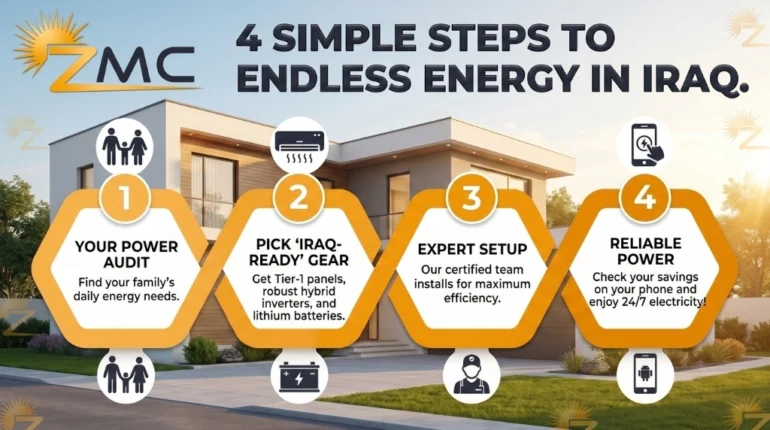
Energy Audit: We look at your home and see how much power you use.
System Design: We decide if an on-grid, off-grid, or hybrid system is best for you.
Quotation: We give you a clear price with no hidden fees.
Installation: Our team sets up the panels and batteries safely.
Start Saving: You turn on your system and start using the sun!
Frequently Asked Questions:
Yes, but it produces less power. On cloudy days, a hybrid solar system in Iraq will pull a little power from the grid or your batteries to help out.
Yes! A properly sized solar system can run your AC during the hot summer months. This is one of the main reasons people choose residential solar systems in Iraq.
Yes ZMC Solar provides Solar Installation service. ZMC Solar has a dedicated engineering team for both commercial and large residential projects across Iraq.
Most high-quality panels last for 25 years or more. They are a very stable investment for your home.
Not at all. Our team handles the wiring so the switch is automatic. You won’t have to go outside to pull any levers.