
Hybrid Solar System in Iraq: The Complete 2026 Guide for Homes and Businesses
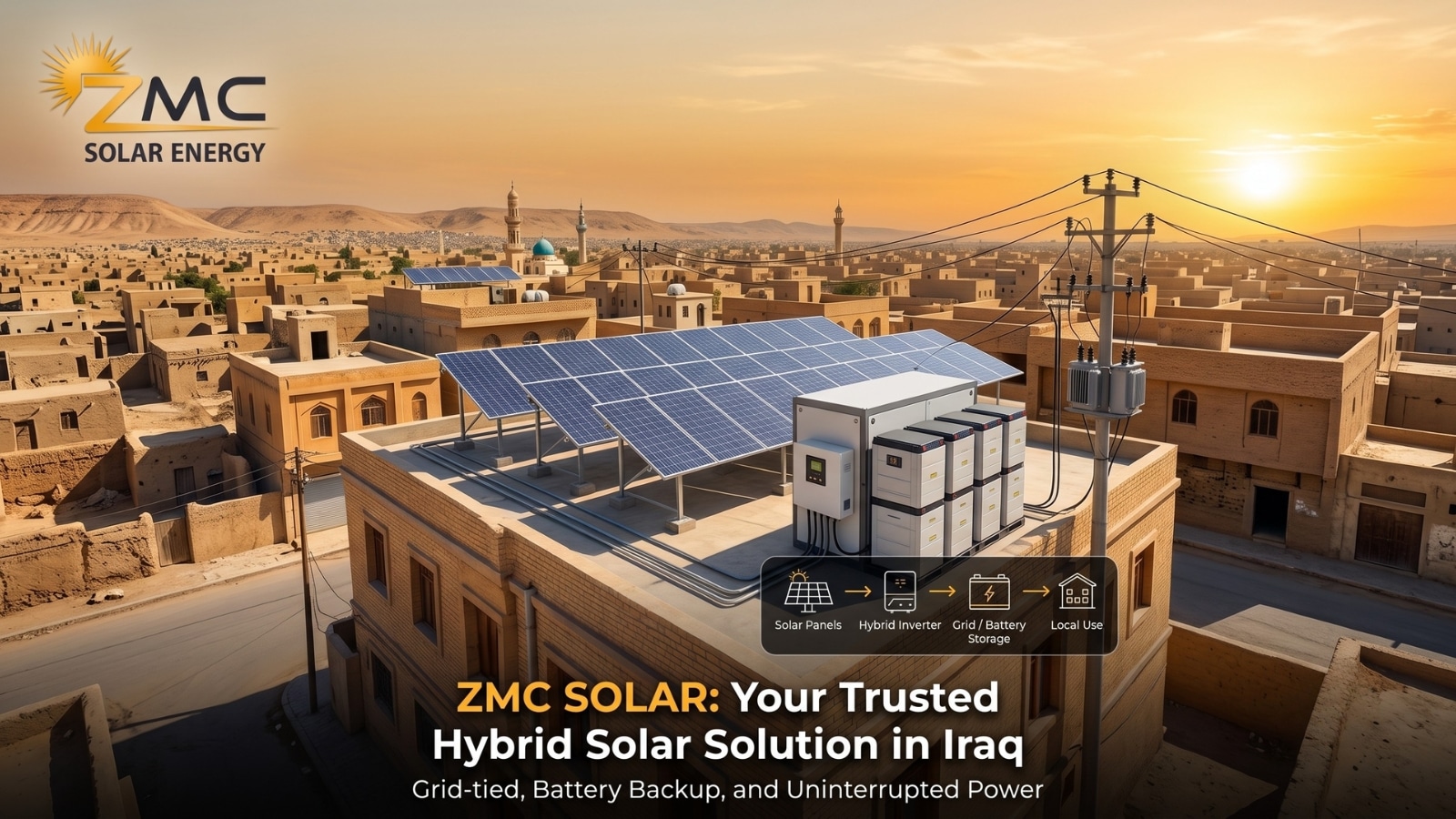
A hybrid solar system in Iraq is the smartest energy investment an Iraqi home or business can make in 2026. It connects solar panels, a lithium battery bank, and the national grid into one intelligent system — giving you clean power during the day, stored backup power at night, and automatic switching in under 10 milliseconds the moment the grid goes down. No generator. No fuel costs. No waiting in the dark.
Iraq generates roughly 18,000 MW of electricity against demand that exceeds 30,000 MW, surging to 50,000 MW in summer. That gap is why hybrid solar — not a standard grid-tied system — is the right answer for most Iraqi households and businesses in Baghdad, Erbil, and beyond. This guide explains exactly how hybrid systems work, what they cost, what government financing is available, and how to choose the right size for your needs.
What Is a Hybrid Solar System?
A hybrid solar system is a power setup that combines the best features of both grid-tied and off-grid solar installations. It uses solar panels to generate electricity, stores surplus energy in a battery bank, and stays connected to the national grid as a backup — all managed by a single hybrid inverter that makes decisions automatically.
The key difference from a standard solar system is the battery. A grid-tied system (on-grid) sends unused solar power back to the grid but leaves you powerless during a grid failure. A hybrid system stores that same surplus in your own batteries, so when the grid cuts out, your home or business keeps running without interruption.
In Iraq, where outages can last 8–16 hours per day depending on the season, this distinction is not a minor feature — it is the entire point.
Why Iraq Needs Hybrid Solar Specifically
Iraq enjoys over 3,000 hours of sunshine annually, making it one of the best countries in the world for solar energy production. Yet despite this natural abundance, the country’s electricity infrastructure has long struggled to keep pace with demand. The energy shortfall reached approximately 12,000 MW during the 2025 summer peak and is expected to remain a challenge through the decade.
The result for households and businesses is an uncomfortable dependence on diesel generators — expensive, loud, polluting, and increasingly difficult to justify when solar alternatives exist. A hybrid solar system eliminates this dependence by:
- Running your appliances on free solar power during daylight hours
- Storing excess generation in a battery that powers your home after sunset
- Using the grid only when both solar and battery are insufficient
- Switching to battery backup in under 10 milliseconds during a grid failure, invisibly and automatically
Two additional policy changes in 2026 make this the most cost-effective time to install. In March 2026, Iraq cut import tariffs on solar equipment from 33% to 5%, directly reducing hardware costs. The Central Bank of Iraq has also allocated IQD 6 trillion through Cihan Bank and Rasheed Bank to finance residential solar purchases at low or zero interest — with loan amounts up to 30 million IQD (approximately $22,890) and repayment periods up to seven years.
How a Hybrid Solar System Works
Understand how solar panels, batteries, hybrid inverters, and the grid work together to keep your home powered throughout the day and night.
Solar Generation
During daylight hours, your solar panels convert sunlight into DC electricity. In Iraq's climate, a quality 400W panel can produce approximately 1.5–2 kWh per day, with output peaking between 9 a.m. and 3 p.m.
Hybrid Inverter Management
The hybrid inverter converts DC power from the panels into AC power for your appliances. It simultaneously monitors battery charge level, grid status, and your household load, then automatically decides how to allocate available power.
Battery Charging
Any solar electricity your home does not use in real time flows into the battery bank. Modern LiFePO₄ lithium batteries charge rapidly and can operate safely at temperatures up to 55°C — a critical requirement for Iraq's summer climate.
Night & Grid-Failure Mode
When the sun sets or the grid cuts out, the inverter switches to battery power in less than 10 milliseconds. For most appliances — including air conditioners, refrigerators, medical equipment, and computers — this switchover is completely unnoticeable.
Grid Fallback
If your batteries run low overnight and the grid is available, the system pulls a small amount from the grid to top up, preventing a complete blackout. You control the minimum battery reserve level through the inverter's settings or a smartphone app.
Key Components of a Hybrid Solar System in Iraq
Every hybrid solar system consists of four core elements. The quality of each component determines long-term reliability, efficiency, and performance in Iraq's demanding climate.
Solar Panels
Solar panels are the engine of the system. For Iraq's high-temperature, high-irradiance environment, you need panels rated for performance in extreme heat. Standard panels lose output efficiency above 25°C, while premium-grade modules use temperature coefficients designed to maintain higher output during summer peak temperatures.
Canadian Solar panels → — distributed by ZMC Solar — are Tier-1 certified and include performance warranties that account for high-temperature degradation, making them a proven choice for the Iraqi climate. Most residential systems use between 6 and 20 panels depending on household energy consumption.
Hybrid Inverter
The hybrid inverter is the brain of the system. Unlike a standard inverter, it manages three simultaneous inputs — solar panels, battery bank, and grid connection — and switches between them automatically without user intervention.
Look for models with MPPT (Maximum Power Point Tracking) charge controllers, which improve energy transfer efficiency by up to 30% compared to older PWM technology.
For Iraqi conditions, an inverter with a wide input voltage range, high ambient temperature tolerance, and a minimum IP65 dust/moisture rating is essential to protect against sandstorms.
Lithium Battery Storage
The battery bank is what makes a hybrid system genuinely useful in Iraq. In 2026, LiFePO₄ (Lithium Iron Phosphate) batteries are the clear standard.
They deliver 6,000+ charge cycles at 80% depth of discharge, last 10 years or more, operate safely at temperatures up to 55°C, and charge significantly faster than lead-acid alternatives.
For a household of four to six people in Baghdad or Erbil, a 10 kWh battery bank provides approximately 8–12 hours of backup power under normal load. A 15 kWh bank extends that coverage to 16+ hours, comfortably covering the longest grid outages.
Explore solar battery options in Iraq → to compare capacities and brands available through ZMC Solar.
Mounting, Wiring & Charge Controllers
Quality mounting hardware rated for corrosion resistance matters in Iraq's sandy, high-UV environment. Frames should be anodized aluminum or galvanized steel, capable of handling wind loads and thermal expansion.
The wiring and conduit must be UV-rated for rooftop exposure. These components are often underestimated in budget comparisons but significantly affect system longevity, safety, and long-term performance.
Choose corrosion-resistant mounting, UV-rated wiring, and properly protected electrical connections for long-term reliability.
Why Component Quality Matters
A hybrid solar system is only as reliable as its weakest component. Choosing equipment designed for Iraq's heat, dust, UV exposure, and grid conditions helps maximize energy production and system lifespan.
How Much Does a Hybrid Solar System Cost in Iraq?
With the 2026 tariff reduction in effect, hybrid solar system pricing in Iraq has become significantly more accessible. The ranges below reflect typical installed costs for complete systems.
5 kW + 10 kWh
Suitable for: Small apartment / 2–3 rooms
- 5 kW solar capacity
- 10 kWh battery storage
- Residential installation
- Panels, inverter, wiring & labour
10 kW + 15 kWh
Suitable for: Average family home
- 10 kW solar capacity
- 15 kWh battery storage
- Extended backup capability
- Complete residential installation
15 kW + 20 kWh
Suitable for: Large home / small business
- 15 kW solar capacity
- 20 kWh battery storage
- Higher daily energy production
- Residential & light commercial use
30 kW+
Suitable for: Shop, clinic, small hotel
- 30 kW+ solar capacity
- Commercial-scale battery storage
- Designed for higher energy loads
- Commercial installation & labour
These figures represent typical installed costs including solar panels, hybrid inverter, battery bank, mounting, wiring, and labour. They do not include government loan offsets. Actual pricing can vary depending on equipment brands, installation requirements, system configuration, location, and battery capacity.
How Quickly Can a Solar System Pay for Itself?
Typical residential payback period, depending on energy consumption and system configuration.
Potential commercial payback period where generator and grid costs are significantly higher.
For most residential installations, the payback period — the point at which energy savings offset the upfront cost — is now under four years. Commercial systems with higher baseline generator costs can often recover their investment in under three years.
What Size Hybrid Solar System Do You Need?
Sizing your system correctly is one of the most important technical decisions you will make. An undersized system leaves you with unmet energy needs, while an oversized system costs more upfront than necessary.
Start With Your Daily Energy Consumption
The starting point is your daily energy consumption in kilowatt-hours (kWh). You can estimate this by listing your main appliances and calculating how many hours you use each one.
1.5-Ton Air Conditioner
≈ 1.5 kWh / hourRefrigerator
≈ 1–1.5 kWh / dayLED Lighting — Full Home
≈ 1 kWh / dayTelevision
≈ 0.1–0.2 kWh / hourFor a Typical Iraqi Family Home
A typical Iraqi family home consuming approximately 20 kWh per day needs around 10–12 solar panels rated at 400W each, paired with a 5–8 kW hybrid inverter and a 10–15 kWh battery bank. Actual requirements vary depending on appliance usage, peak loads, backup requirements, location, and available sunlight.
Solar Panels for Your Home in Iraq
Explore our guide to choosing the right solar panel system for residential energy needs.
Commercial Solar Energy Solutions
Learn about solar systems for shops, clinics, offices, hotels, and larger commercial buildings.
Not Sure What Size System You Need?
A professional site assessment can help determine the right panel, inverter, and battery capacity for your actual energy consumption.
ASSESSMENT
Hybrid vs. Off-Grid vs. On-Grid: Which Is Right for Iraq?
The three main solar configurations each suit different situations. Here's how they compare for homes and businesses in the Iraqi context.
| Feature | On-Grid | Off-Grid | RECOMMENDED Hybrid |
|---|---|---|---|
| Works during grid outage | No | Yes | Yes |
| Requires battery storage | No | Yes | Yes |
| Grid connection | Required | Not used | Optional |
| Upfront cost | Lowest | Highest | Mid-range |
| Best for Iraq? | No | Rural only | Yes — most homes |
On-Grid
On-grid systems are the least expensive option because they do not require batteries. However, they stop producing usable power during a grid outage, which makes them a poor fit for areas with unreliable electricity.
Off-Grid
Off-grid systems operate completely without the utility grid, making them useful for remote or rural locations. The trade-off is a much larger battery bank to cover overnight use and consecutive low-sun days.
Hybrid
Hybrid systems combine solar panels, battery storage, and optional grid support. They provide meaningful backup power during outages while keeping costs below a fully off-grid system.
Why Hybrid Systems Make the Most Sense in Iraq
Hybrid systems hit the right balance for most Iraqi households: reliable backup power during outages, lower battery requirements than a fully off-grid system, and the utility grid available as a safety net rather than a dependency.
For a more detailed technical breakdown of system design, battery requirements, and operating differences, read our on-grid vs. off-grid solar comparison .
Frequently Asked Questions
Can a hybrid solar system run AC in Iraq's summer?
Yes. Solar power can run your AC during the day, while batteries provide power during the evening and grid outages. For a 1.5-ton air conditioner, you need at least a 5 kW solar array and 10 kWh battery, although the exact requirement depends on the AC's efficiency, usage hours, other household loads, and desired backup duration.
How long do solar batteries last in Iraq's heat?
LiFePO4 lithium batteries are designed to handle high temperatures and can operate at temperatures of up to 55°C. With proper installation and thermal management, they can typically last around 10–15 years. This is significantly longer than traditional lead-acid batteries, which may last only 3–5 years under demanding conditions.
Is there government support for buying a solar system in Iraq?
Yes. Government-backed financing has helped make solar systems more accessible in Iraq. The Central Bank of Iraq's solar financing programme has included loans of up to 30 million IQD, approximately $22,890, with repayment periods of up to seven years and favourable financing terms. Solar import tariffs were also reduced to 5% in 2026.
How fast does a hybrid system switch during a power cut?
A properly configured hybrid inverter can switch to battery backup in under 10 milliseconds, depending on the inverter model and operating mode. This is fast enough that many household devices continue operating without an obvious interruption.
What is the payback period for a hybrid solar system in Iraq?
A typical residential hybrid solar system in Iraq may have a 3–5 year payback period, while commercial installations with high electricity or generator costs can potentially recover their investment in under three years. Actual payback depends on system cost, energy consumption, generator usage, grid availability, battery cycling, and solar production.